
- Can I order a sample before placing a wholesale apparel order?Sep 24,2026
Yes. You can order a pre-production sample before committing to a bulk wholesale apparel order. We build every sample through the same pattern-making, cutting, sewing and quality-check process we use for mass production, so the piece you approve is the piece we ship. Sampling is charged at USD 50 per style to cover materials and labour, and shipping is billed separately. A reasonable deposit is required when you confirm the production order.
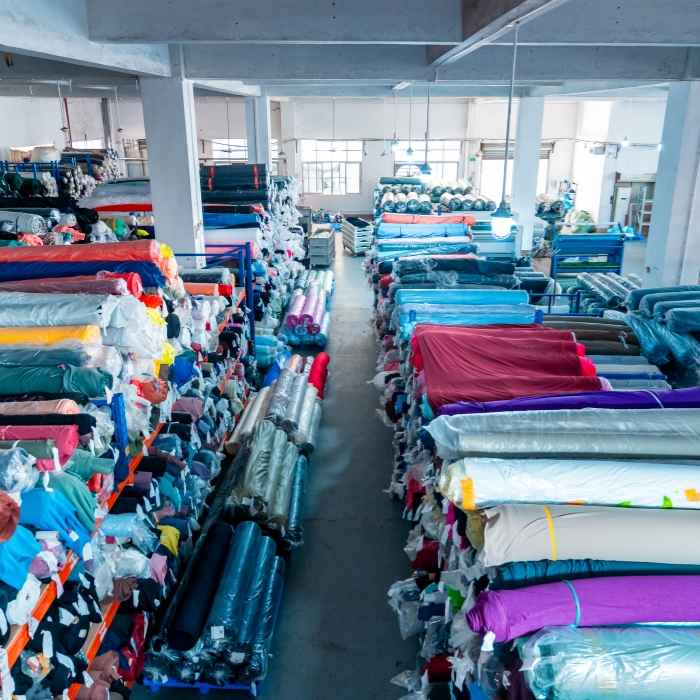
Fabric, trim and colour confirmed before cutting 
Samples run on the same lines as bulk 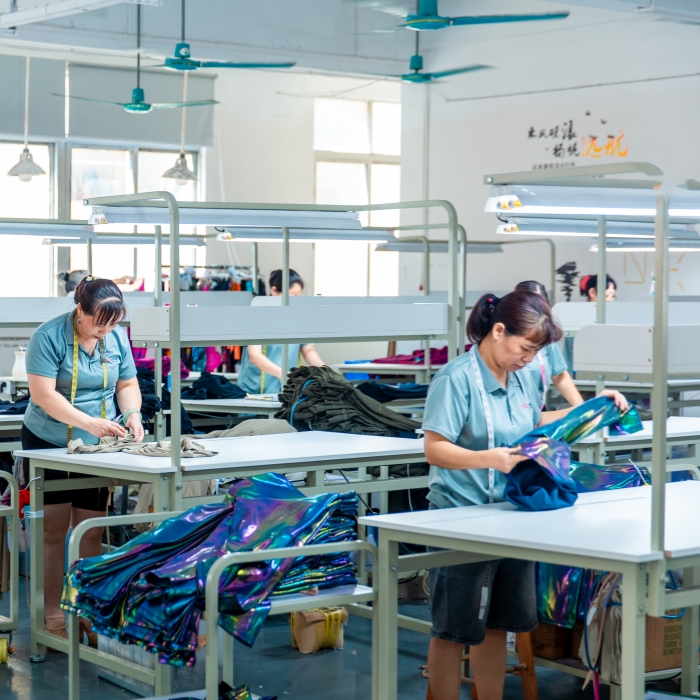
Every sample passes AQL 1.5 inspection What the sampling process looks like
Sampling starts from your tech pack, reference garment or even a rough sketch. Our design team turns it into a measurement sheet and pattern, then confirms fabric, trim and print method with you before anything is cut. Sampling takes 7-10 days for most activewear styles, including sports bras, leggings, hoodies, shorts and training tops. Once the sample is approved, the same pattern and fabric lot specification is locked into your production file.
What your sample includes
- Fit and construction - graded pattern, seam type, elastic and stitch density confirmed on the actual garment.
- Fabric and handfeel - the exact sourced fabric, weight and stretch so you can test it against your target market.
- Branding and trims - woven labels, care labels, zippers, drawcords, silicone prints or embroidery.
- Colour accuracy - lab-dip or Pantone matching so bulk dye lots stay consistent with the approved sample.
- Sample report - measurements and inspection notes so your team can sign off objectively.
How sampling fits your wholesale order
Sampling is a standalone service, so no minimum order quantity is attached to it - you can validate a design before you invest in bulk. When you move to production, a deposit confirms the order and the approved sample becomes the quality reference on our factory floor. For larger programmes we can also produce size sets and sales samples for your showroom or trade show.
Typical timeline: tech pack review within 24 hours, prototyping and sample production in 7-10 days, bulk production about 25 days after approval. Shipments leave from Shenzhen.Still planning your first collection? Read more about our factory or send your design to our team to start a sample.
- What is the response time for quotes or other inquiries?Sep 24,2026
We reply to quotes and inquiries within 1 hour during working hours. Our customer service team is based in the same building as our sample room and production floor, so pricing questions are answered by people who can check fabric stock and line capacity directly rather than forwarding your email around. Inquiries that arrive outside working hours are usually answered the next morning, and complex projects - multi-style collections, custom fabric development, packaging programmes - get a first response within 1 hour plus a complete quotation within 24 hours.
Trusted by 1,200+ sportswear brands 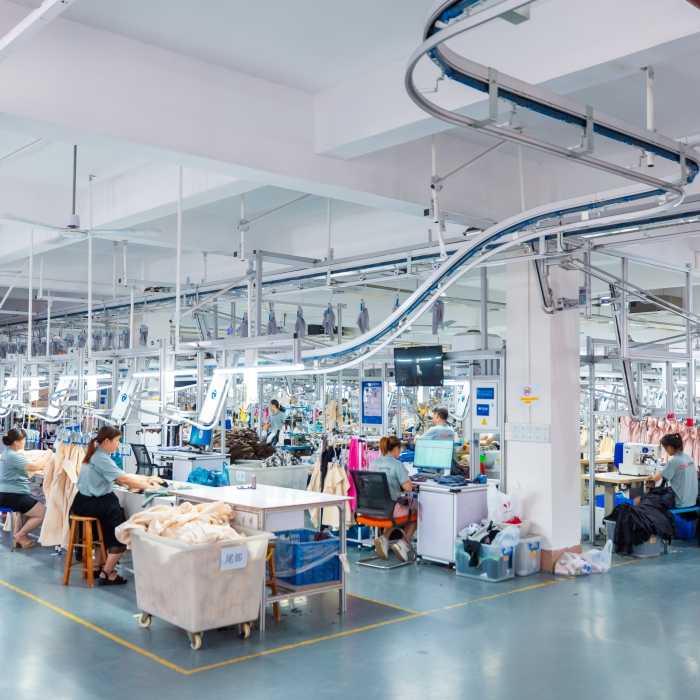
Quotes checked against real material stock Capacity checked before quoting lead time What to send so the first reply is a real answer
- Style and category - sports bra, leggings, hoodie, shorts, training top, or a reference image if you are still defining it.
- Target quantity per style - we quote against real volume, and we will tell you if a flexible MOQ works better for a first run.
- Fabric preference or performance need - compression, moisture wicking, brushed handfeel, recycled content, four-way stretch.
- Branding requirements - woven labels, printing method, embroidery, retail-ready packaging.
- Target market and timing - destination country and your required delivery window, so lead time and logistics are priced in.
What you get back in that reply
A working quotation, not a price list. That normally means unit cost at your quantity, the MOQ we recommend for your stage, fabric options with weight and composition, sampling timeline and fee, bulk lead time, and packing details. If a requirement is not workable we say so in the same message and propose the closest alternative instead of leaving the gap open. Our team has supported more than 1,200 sportswear brand clients, so most categories have already been quoted in your market.
Fastest route to a full quotation: a tech pack earns a precise answer, a reference photo plus measurements earns a close one, and a single line of requirements still earns a reply with the questions we need answered.Ready to price a collection? Read more about our factory or contact our team with your tech pack and target quantity.
- What is the duration for receiving my wholesale apparel order?Sep 24,2026
Sampling runs at about 7 days, and bulk wholesale orders are typically completed within 25 days. The clock starts when your sample is approved, not when the enquiry arrives, because production can only be scheduled against a signed-off reference. From that point we report status continuously rather than leaving you to guess, and finished goods ship from Shenzhen.
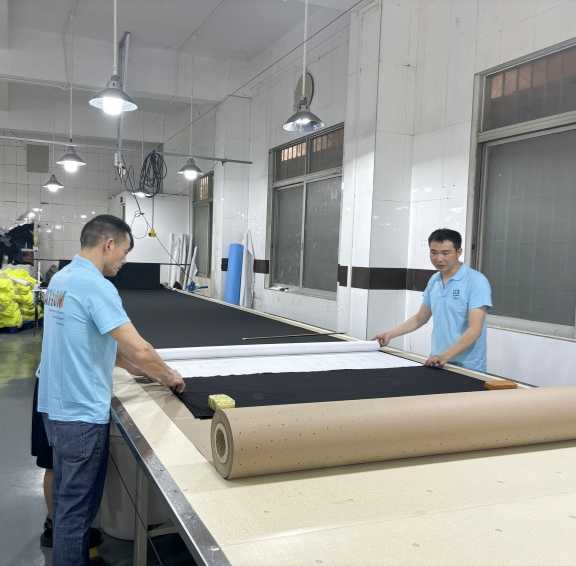
Bulk runs complete in about 25 days Fabric staged before cutting starts Inspection sits inside the timeline How the timeline breaks down
- Quotation - first reply within 1 hour in working hours, a full quotation usually within 24 hours.
- Sampling - about 7 days for most activewear styles, covering pattern, fabric confirmation and the sample itself.
- Bulk production - normally within 25 days after sample approval, running on our smart hanging lines.
- Inspection and packing - final AQL inspection and retail-ready packing are inside that production window, not added to it.
- Shipping - departure from Shenzhen plus transit to your port or door, quoted against your destination.
What can move the date
Fabric is the usual variable. A stock fabric from our 200+ material library keeps the standard timeline; a custom-developed or custom-dyed fabric adds mill lead time before cutting can start. Late changes to fit, colour or branding artwork also push the schedule, since they invalidate work already completed. Orders that need to be faster are handled as rush orders, which have to be flagged when the production order is placed so we can reserve line capacity up front.
How you stay informed
Once your order launches, your dedicated account manager sends weekly status reports with live photos and video covering the critical milestones - fabric cutting, sewing, and final quality control inspection. If a milestone is at risk we raise it in that report rather than at the shipping deadline, so there is still time to react.
Planning backwards from a launch date? Tell us the date the goods must leave Shenzhen and we will confirm whether the standard 25-day run fits or a rush schedule is needed.Read more about our production capacity or send your drop date to our team for a timeline with your quotation.
- Do you offer priority production scheduling or framework agreements for long-term partners?Sep 24,2026
Yes. For established brands and global retailers that need guaranteed capacity all year, we offer strategic framework agreements. By signing an annual capacity retainer, we lock in dedicated production lines and raw material buffers for your brand. In practice that means two things most suppliers cannot promise: pricing that does not drift when fabric markets move, and priority fast-track delivery when the rest of the industry is queuing for line time.
Raw material held for partner brands Line capacity reserved for the term 1,200+ brands supported worldwide What a framework agreement actually secures
- Reserved line capacity - a defined monthly or seasonal output held for your brand, so peak-season demand does not push you to the back of the queue.
- Raw material buffers - core fabrics, trims and elastics held in stock against your programme instead of being re-sourced per order.
- Stable pricing - cost structure agreed for the term, protecting your margin planning from yarn and freight volatility.
- Priority scheduling - fast-track slots for mid-season replenishment and urgent drop dates.
- Continuity of spec - same fabric lots, same colour standards and the same construction file across every release.
Who it suits
Framework agreements make sense when your annual volume is predictable enough to reserve against - DTC brands scaling beyond launch phase, wholesalers running seasonal drops, retailers with fixed replenishment cycles. For a first collection, the standard route is better: place a trial order at our flexible MOQ, validate sell-through, and move to a retainer once your run rate is clear. Both are the same factory; the difference is whether we hold capacity exclusively for you.
How the terms are set
A retainer is built from your forecast, not a template: expected pieces per category across the year, peak months, fabric families, and the replenishment pattern you need. Our team then proposes reserved capacity against your plan, with review points so the agreement flexes as your brand grows. Because we run two factories covering 20,000 m² with a combined monthly output of 500,000 pieces, reserved capacity stays genuinely reserved instead of being raided when a bigger order arrives.
We have supported more than 1,200 sportswear brand clients, and long-term partners are scheduled ahead of one-off orders - including through Q3/Q4 peak.Scaling a programme across seasons? Read more about how we work with partners or ask our team to scope a capacity plan for your forecast.
- Can we get real-time tracking or production updates for our bulk orders?Sep 24,2026
Yes. Once your bulk production is launched on our smart hanging lines, your dedicated account manager provides weekly status reports. Those reports are not a scheduling summary - they include live photos and video of the critical milestones, so you see fabric being cut, garments running down the sewing line, and the final quality control inspection before anything is packed. The point is that you never have to ask where your order stands, and problems surface while they are still cheap to fix.
Your order on our smart hanging lines QC findings reported while in-line 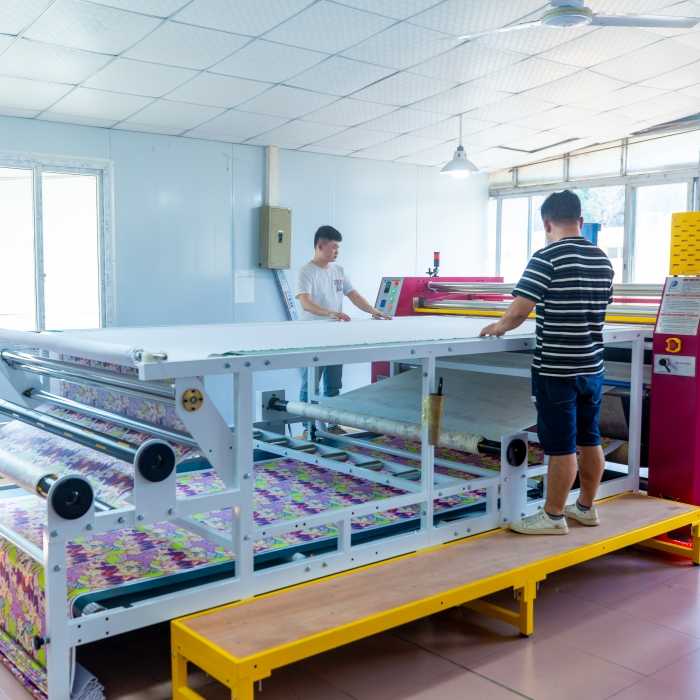
Printing and finishing milestones What each weekly report contains
- Stage and percentage complete - cutting, sewing, finishing, inspection or packing, with the pieces finished to date.
- Live photo and video evidence - your actual garments on the line, not a generic factory image.
- Quality flags - any in-line finding, the corrective action taken, and whether it affects your date.
- Colour and measurement checks - light-box colour verification and measurement against the approved sample.
- Next milestone and date - what happens next and when, so your own logistics planning stays on track.
Why smart hanging lines make this possible
Our production runs on intelligent hanging systems that move garments station to station and record progress as they go. Output per line, per style, per shift is visible to the floor manager and to your account manager in real time - which is why a weekly report can carry accurate numbers instead of an estimate. It also means a bottleneck shows up on the data before it becomes a missed ship date.
Before and after production
Reporting starts at sample approval and continues through final inspection. Once goods leave Shenzhen, tracking information is shared so you can follow the shipment through our logistics partner. For multi-style programmes we report per style, so you can see which colourways are ahead and which need attention rather than waiting for one blended update at the end.
Prefer more frequent updates? Ad-hoc photo requests are fine at any point - your account manager is the single point of contact for the order.Want visibility before you order? Read more about our factory and QC process or ask our team for a sample production report.
- Do you provide flexible private-label packaging and retail-ready presentation?Sep 24,2026
Absolutely. We build comprehensive retail-ready finishing into the order, not as an afterthought. That includes custom recycled polybags, branded tissue paper wrapping, high-density embossed hangtags, woven main labels, care labels compliant with regional law such as FTC and EU guidelines, and custom-sized master cartons so your products arrive in pristine condition. The goal is that your goods can go straight onto a shelf, into a fulfilment centre or to a customer's door without being repacked.
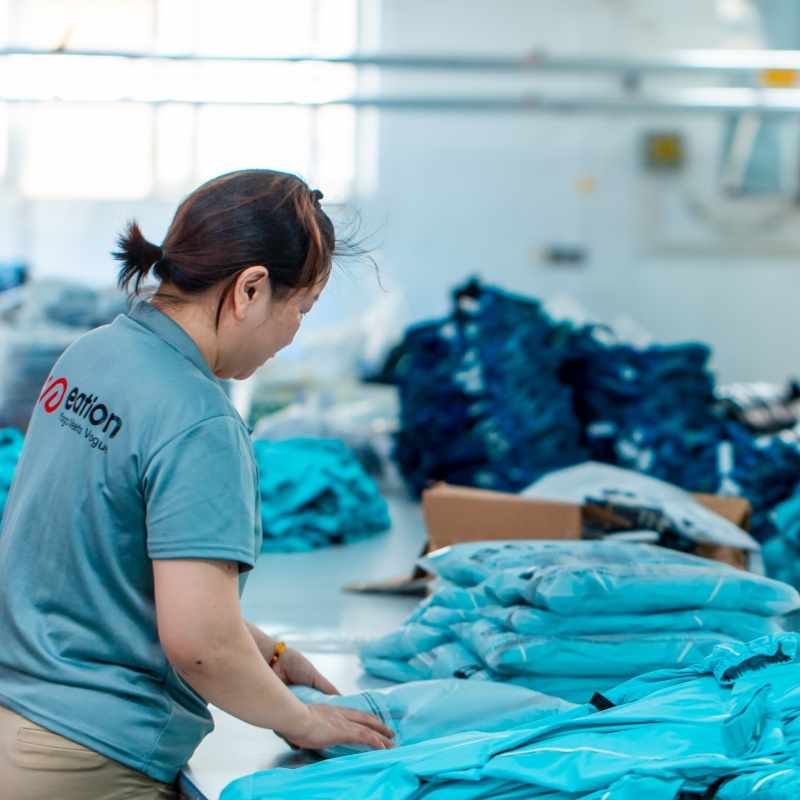
Retail-ready packing built into the order Presentation that reaches the shelf intact Hangtags, labels and inserts What a retail-ready pack can contain
- Inner packaging - recycled or custom-printed polybags, branded tissue wrap, kraft or printed boxes with your artwork.
- Hangtags and cards - high-density embossed hangtags, barcode and price-tag attachment, product information inserts.
- Labels - woven main labels, size labels, and care labels written to your destination market's legal requirements.
- Channel-ready extras - barcodes and SKU labels for retail or marketplace intake, size stickers, polybag suffocation warnings where required.
- Outer cartons - custom-sized master cartons with your shipping marks, carton counts and packing list configuration.
Why the carton size matters more than people expect
Custom-sized master cartons are not cosmetic. Cartons dimensioned to your folded garment size reduce void fill, cut volumetric shipping cost on air freight, improve pallet utilisation, and lower transit damage because garments cannot shift. For ecommerce clients we often pack to the fulfilment centre's intake spec, so cartons can be cross-docked without repacking.
How to brief the packaging
Send your packaging artwork, barcodes and any retailer or fulfilment-centre specification with the order, and confirm them at the sampling stage rather than after production. We will show you the packed presentation in your sample so you can approve the real thing. If you are still deciding, we can propose two or three configurations at different cost points, from a basic polybag and hangtag to a full branded unboxing set.
Care-label content and packaging claims are checked against your destination market before production, so a launch does not stall at customs or at retail intake.Planning a branded unboxing experience? Read more about our value-added services or send your packaging brief to our team.
- Can you source and develop custom trims, custom zippers, and premium hardware?Sep 24,2026
Yes - we offer full-service sourcing for customized branding hardware. We work directly with leading trim suppliers to develop custom-engraved metal aglets, branded heavy-duty zippers including waterproof matte YKK options, embossed silicone patches and custom-woven drawcords built to your exact specifications. Trims are where a garment either reads as premium or reads as generic, so we treat them as a design decision rather than a purchasing line item.
Engraved hardware and trims developed in-house 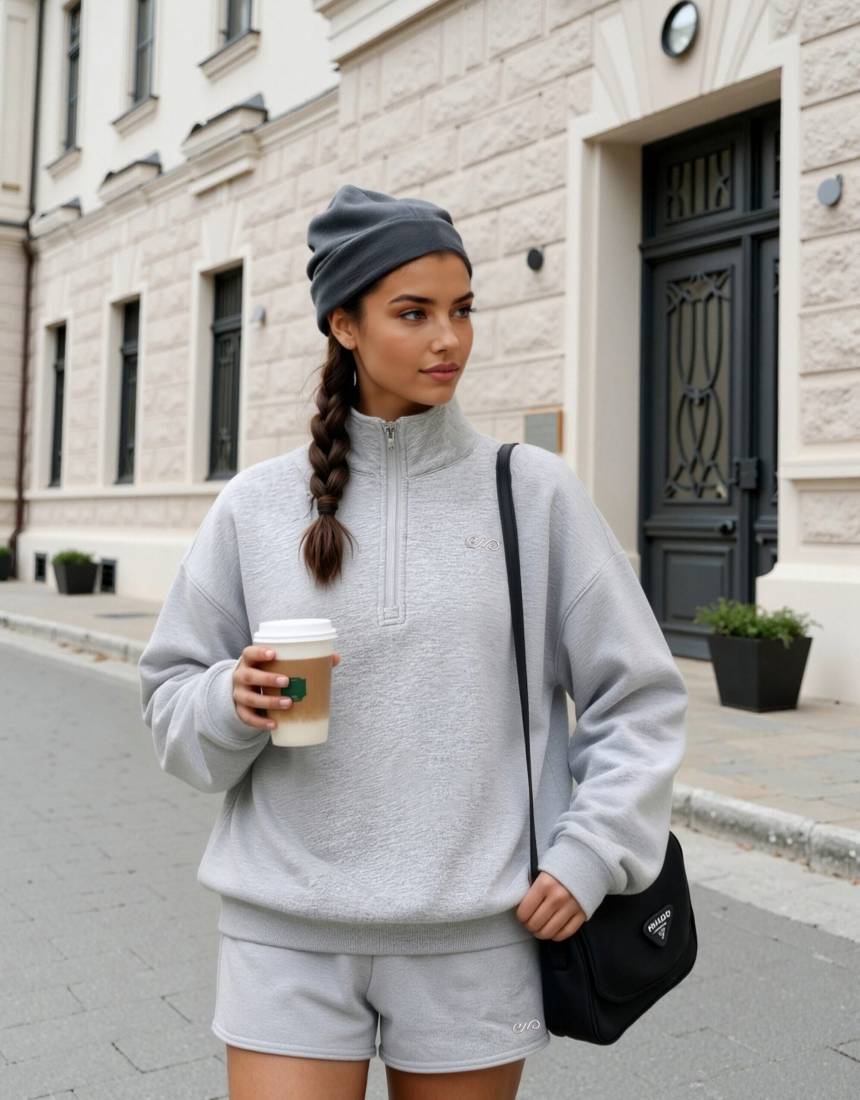
Branded zippers on bulk production Woven drawcords matched to fabric What we can develop
- Zippers - branded pulls and sliders, heavy-duty and waterproof matte YKK options, custom tape colour to match the garment.
- Metal hardware - custom-engraved aglets, cord locks, eyelets, rivets, buckle ends and logo-embossed stoppers.
- Drawcords and elastics - custom-woven or knitted drawcords with your pattern, jacquard elastic waistbands, silicone-gripped bands.
- Silicone and rubber details - embossed or printed silicone patches, grip strips, brand tabs and moulded logos.
- Labels and closures - woven labels, printed tags, hook-and-loop closures and snap buttons with your branding.
Why sourcing trims in-house matters
When trims are bought separately by the client, mismatched dies, delayed deliveries and colour drift become the client's problem, and they land in the middle of a production run. We develop hardware alongside the sample, so the trim on the approved sample is the trim we can actually order in volume. That single point of accountability is why trims rarely delay an order here - the supplier, the die and the colour specification are already locked before cutting starts.
Cost and minimums
Engraved and moulded hardware carries tooling, so custom dies usually make sense at higher volumes; below that we steer you to existing moulds with your brand applied by laser engraving or pad printing. Custom-woven drawcords and jacquard elastics have their own minimums per pattern. Tell us your target quantity with the design and we will tell you where the sensible threshold sits instead of pushing you into tooling you cannot amortise.
Send reference photos, dimensions and your target volume. We will come back with available options, tooling implications and lead time per trim.Building a premium capsule? Read more about our craftsmanship or send your trim references to our team.
- How do you protect our proprietary designs and intellectual property (IP)?Sep 24,2026
We treat intellectual property with the utmost seriousness, starting with a formal NDA signed before any tech pack, sketch or exclusive fabric pattern is shared. Your custom developments and private moulds are never displayed in our public showrooms or reused for other clients without your explicit written authorisation. Protection is contractual and operational, not a polite promise.
Custom moulds quarantined IP protected by contract and practice Confidential files access-controlled The protection framework
- Contractual NDA - a binding agreement in place before confidential material changes hands.
- Exclusive pattern control - graded patterns and construction files held against your brand only.
- Private mould quarantine - custom dies, trims and moulds not shared or reused without authorisation.
- No showroom disclosure - your developments are kept out of public display and competitor view.
- Written authorisation required - any reuse of your IP needs your explicit, documented consent.
Why IP protection matters in manufacturing
A factory sits between a brand and the market, and a weak IP posture is the fastest way a bestselling design becomes a commodity sold by someone else. We close that gap with both paper and practice: the NDA sets the legal boundary, and operational controls - restricted file access, quarantined moulds, no public display - make the boundary real on the floor. For brands whose product is their differentiation, that discipline is part of the value we provide, not a footnote.
Handling sensitive or exclusive work
If your programme includes exclusive fabric, a signature trim or a private mould, tell us at the briefing stage so we flag it in the production file and apply the stricter controls from sampling onward. The same NDA covers the whole relationship, so a style developed this season stays yours when you reorder next season. Should you ever exit a programme, the confidential assets are returned or destroyed per the agreement rather than retained.
Have exclusive patterns, trims or moulds? Flag them at briefing and we will apply quarantined handling from the first sample.Read more about our IP protection practice or ask our team to put an NDA in place before you share anything.
- Do you support sustainable fabric options for eco-friendly collections?Sep 24,2026
Yes. Sustainability is built into our material programme, not bolted on. We source recycled polyester and nylon, organic cotton and biodegradable fibres from GRS-certified mills, and we can supply the mill documentation your market needs to make a recycled claim that survives scrutiny. For a next-season eco line, the starting point is usually a recycled substitution of the performance fabric you already want.
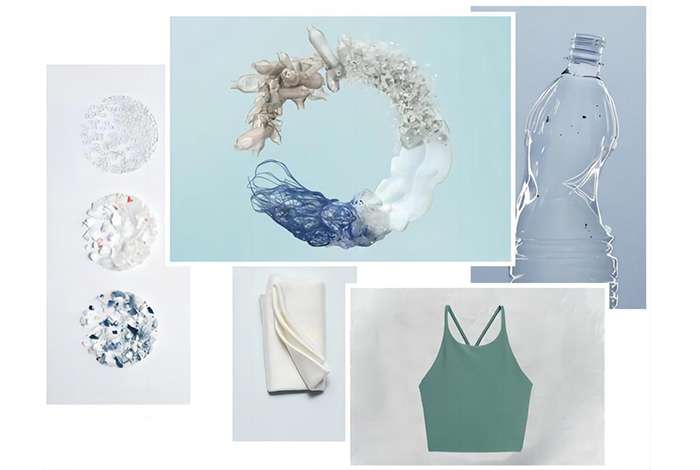
GRS-certified recycled supply Organic and bio-based options Low-impact finishing available Materials we can source
- RPET recycled polyester - from post-consumer bottles, with the same wicking and print performance as virgin polyester.
- Recycled nylon - regenerated from industrial and ocean-bound waste for leggings, swim and outer layers.
- Organic cotton - for low-intensity and lounge styles where softness and breathability lead.
- Bio-based and biodegradable fibres - plant-derived and compostable options for selected constructions.
- Tencel and other cellulosics - closed-loop fibres with a lower water and chemical footprint.
Certifications and compliance
Because we hold GRS and OEKO-TEX certification, a recycled or low-impact claim on your garment can be traced to the mill and the batch rather than resting on a supplier's word. We provide the documentation required for EU and US market access - fibre content, restricted substances and care labelling - so an eco claim does not stall at customs or at a retailer's compliance gate. If your brand carries its own standard, such as a specific recycled content percentage, we build the fabric and the paperwork to meet it.
Designing an eco line that still performs
Sustainability and performance are not a trade-off here. Recycled polyester wicks and prints as well as virgin; recycled nylon matches the abrasion resistance of conventional nylon. The design work is in balancing recycled content, handfeel and cost, then confirming it at sampling. We will show you a recycled and a conventional option side by side so the decision is informed by touch, not just by a spec sheet.
Selling into the EU or US? Tell us the standard you need to meet (GRS content, OEKO-TEX, fibre claims) and we will match fabric and documentation.Read more about our certified materials or send your sustainability brief for a fabric plan.
- Do you have experience exporting to our specific region (US/Europe/Australia)?Sep 24,2026
Yes. We have exported since 2009, with a strong, ongoing presence in the United States, Europe and Australia. That history means we do not learn your market's rules on your order - we already build to them: regional regulations, labelling laws and packaging standards are part of the spec, not a last-minute scramble.
1,200+ brands served worldwide Labels and packing per market Exporting since 2009 Regional experience we bring
- United States - FTC care-label content, fibre composition and CPSIA awareness for apparel.
- European Union - care-label and fibre-content rules, REACH restricted-substance compliance, CE where applicable.
- Australia - labelling and import requirements for garments sold locally.
- Marketplace readiness - barcodes, FNSKU and packing to fulfilment-centre intake specs.
- Documentation - certificates and test records supplied for customs and retailer compliance.
How that helps your launch
A supplier's regional experience shows up in the things that stall a launch: a care label that fails a market's wording rule, a carton that a fulfilment centre rejects, a recycled claim with no paperwork. Because we have shipped into these regions for well over a decade and supported more than 1,200 brand clients, those details are baked into the order template per destination. You tell us where the product sells and we configure labels, packing and documents to match, so goods clear instead of sitting in a warehouse awaiting correction.
Beyond the three core regions
While the US, Europe and Australia are our heaviest lanes, we export worldwide and treat each destination's requirements as a configurable part of the order rather than an exception. If you sell into multiple regions from one style, we can produce market-specific labels and packing within the same production run. For a new market we research the rules with you up front, during sampling, so compliance is confirmed before bulk - not discovered at the border.
Tell us every region you sell into, even future ones, and we will build labels and packing to cover them from the first order.Read more about our export experience or ask our team about your target market's requirements.
- How do you handle color consistency and quality control across large orders?Sep 24,2026
Consistency across a large order comes from inspecting every batch, not just the last one. Large runs move on our smart hanging lines under AQL 1.5 inspection, and every batch gets light-box colour verification, shrinkage testing and needle detection before it is packed. With a monthly capacity of 500,000 pieces, volume is a scheduling decision for us, not a reason to relax the checks.
Large runs on controlled lines Light-box colour per dye lot Volume scheduled, not rushed Colour consistency by the batch
- Light-box colour checks - every dye lot verified under standard lighting against the approved master, not eyeballed.
- Lab-dip master - the approved colour dip is the reference the mill dyes against, keeping lots aligned.
- Measurement control - graded patterns and in-line checks stop measurement drifting across thousands of units.
- Shrinkage testing - fabric and finished garments tested so size stays true after wash.
- Needle detection - metal screening before packing protects the end customer.
Why smart hanging lines help
Our intelligent hanging systems move garments station to station and record output per line, per style, per shift. That visibility means a bottleneck or a quality flag shows up in the data before it becomes a missed ship date, and it means a large order can be split across lines while still being checked to the same standard. Volume does not get rushed through a weaker process - it gets spread across capacity that is already controlled.
From first garment to last
The practical result is that piece number one and piece number fifty-thousand read as the same product: same colour, same measurement, same construction. Because the approved sample is locked into the production file and every batch is checked against it, a reorder or a replenishment later in the season matches the launch run. For enterprise programmes that is usually the difference between a smooth repeat and a Colour Matching crisis.
Running an enterprise programme? Ask for per-batch colour and measurement reports so consistency is documented across the whole order.Read more about our production capacity or send your volume forecast for a controlled production plan.
- What specialized stitching and garment construction technologies do you offer?Sep 24,2026
Our lines run specialised construction technologies that most general garment factories cannot offer. That includes four-needle six-thread flatlock stitching for zero-chafe seams, ultrasonic thermal bonding for seamless aerodynamic gear, and precision laser cutting for perfect panel symmetry. The right construction is chosen per garment, because a seam that chafes in a training top is a defect, not a detail.
Four-needle six-thread flatlock Laser-guided panel cutting 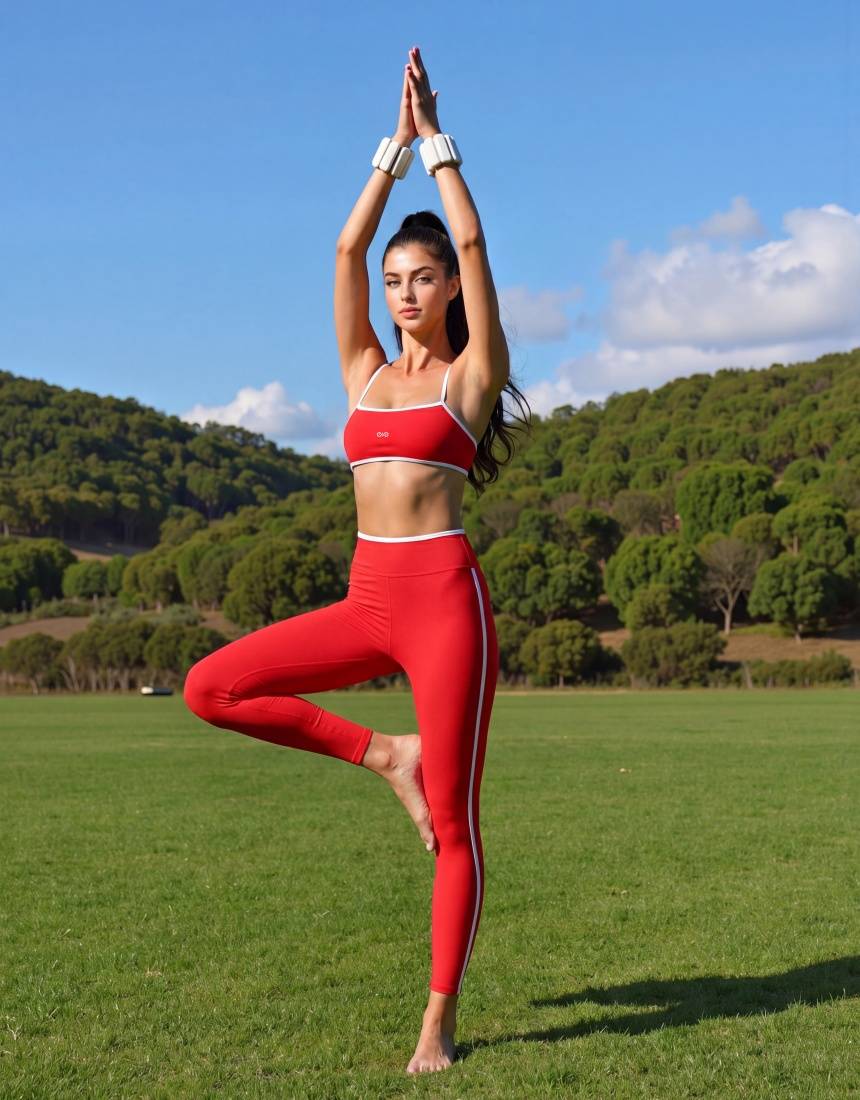
Bonded and flat seams Construction technologies
- Four-needle six-thread flatlock - a flat, low-bulk seam that sits flat against skin for zero-chafe athletic wear, hoodies and cycling jerseys.
- Ultrasonic thermal bonding - heat-sealed seams with no thread, for aerodynamic, waterproof and seamless performance gear.
- Precision laser cutting - computer-guided cutting for accurate panel symmetry across sizes and across the run.
- Coverstitch and flatseam finishes - clean, stretch-stable hems and cuffs that survive industrial wash.
- Engineered elastic application - power-band waistbands and encased elastics applied to spec for compression and recovery.
Why construction choice matters
A garment's feel is decided as much by how it is sewn as by the fabric. Flatlock seams remove the ridge that rubs during movement; bonded seams remove thread altogether for a second-skin finish; laser cutting removes the human variance in panel alignment so a size M is a size M every time. We match the technique to the performance brief, then confirm it on the sample so you feel the seam before committing to bulk.
From sample to scale
Once a construction method is approved on the sample, the same machines, settings and operators' standards are locked into your production file. Because the construction is documented per style, a large reorder reproduces the exact seam and finish of the original - which is why a technology-led style stays consistent as you scale. If a new technique would improve your product, our team will propose it at the development stage rather than defaulting to the cheapest seam.
Building a performance or seamless line? Tell us the activity and the handfeel you want and we will specify the construction method.Read more about our craftsmanship or send your tech pack for a construction proposal.
- Can you assist with custom fabric development and color matching?Sep 24,2026
Yes - fabric innovation is one of our core strengths. We develop custom knits and finishes, from high-weight French terry for streetwear hoodies to specialised moisture-wicking constructions for training gear, and we match colour to your Pantone reference under a standard light box to about 99% accuracy. The aim is a fabric that is unmistakably yours, not a catalogue cloth with your label on it.
French terry and technical knits Lab-dip matched under light box Approved lots held to spec Custom fabric development
- French terry and fleece - weight, loop and brush tuned for hoodies, joggers and lounge sets.
- Moisture-wicking knits - channel or cross-section yarns for fast sweat transport in training wear.
- Eco nylon and performance blends - recycled or bio-based bases for premium and swim lines.
- Surface and finish - brushed, bonded, peached or printed faces for a distinct handfeel.
- Weight and gauge - composition and knit density set so the fabric performs and prices to target.
How colour matching works
Colour is matched from your Pantone or physical reference through a lab-dip process, then verified under a standard light box so the result is judged under controlled lighting rather than showroom glare. We target around 99% accuracy against the reference, and the approved dip becomes the master the mill dyes against. Because a dye lot can shift, every bulk batch is re-checked against that master under the same light box before cutting - that is what keeps a 10,000-piece run the same colour as the approved sample.
From development to bulk production
Once a custom fabric and its colour are approved at sampling, both are locked into your production file by specification and lot. Reorders reuse the same cloth, so a colourway you launch this season still matches when you replenish next season. If you are developing a signature fabric, we can also hold buffer stock against your forecast so a bestseller is never waiting on a mill lead time.
Send a Pantone number, a swatch or a competitor fabric and we will return lab-dips and a composition proposal for approval.Read more about our fabric innovation or send your reference for a development quote.
- How do you manage production for large-scale orders?Sep 24,2026
For large orders we assign dedicated production lines and a project manager who oversees the entire process. Volume is not simply pushed into a shared queue - your order gets its own line time, its own quality reference and one person accountable for schedule and consistency from cutting to packing. That structure is what keeps a 50,000-piece run as predictable as a 300-piece trial.
Dedicated lines for large runs Enterprise programmes handled in full AQL 1.5 across 8 checkpoints What "dedicated" means on the floor
- Line allocation - specific sewing lines reserved for your style for the duration of the run, so your output is not competing with other clients' orders.
- One project manager - a single owner for scheduling, materials, inspection results and reporting, instead of a chain of handovers.
- Material planning up front - fabric, trims, labels and packaging quantities locked and staged before cutting begins.
- In-line control - AQL inspection at 8 checkpoints rather than only at the end, so defects are caught per batch instead of after 50,000 pieces.
- Weekly reporting - progress, live production photos and quality findings sent to you as the run advances.
Where large orders usually fail elsewhere
Most large-volume problems trace back to three things: colour drift between dye lots, measurement creep when a pattern is graded across many sizes, and packaging mismatches at the end of the run. We control them by holding a single approved sample as the reference, verifying colour under a standard light box on every batch, and confirming packing configuration before the first carton is sealed. Our monthly capacity of 500,000 pieces across two factories means a large order does not have to be rushed to fit a deadline.
Scaling within one order
Large orders are frequently multi-style programmes rather than one huge SKU, so the project manager also handles sequencing - which style runs first, how colourways are grouped to reduce changeover loss, and when reorders can slot in. If your forecast grows mid-season, we can extend line allocation for the same style because the pattern, fabric lot and construction file are already locked.
Running a programme over multiple drops? Read more about our capacity or ask our team to scope dedicated line time across the season.Send your volume and style breakdown to our team for a production plan with the schedule and inspection checkpoints spelled out.
- How do you ensure the quality of the raw materials used in production?Sep 24,2026
Material quality is controlled before cutting begins, not discovered after. We qualify suppliers up front, inspect every incoming lot for weight, composition and colour, and only run certified sustainable materials where a programme calls for them. With a library of 200+ fabrics, most orders draw from cloth we have already vetted, which removes a whole class of incoming risk.
Incoming lots inspected on arrival Weight, colour and composition checked GRS and OEKO-TEX certified supply Supplier qualification
- Audited mills - suppliers are assessed for capability and consistency before they enter the approved list.
- Certified materials - GRS and OEKO-TEX certified supply for recycled and low-impact programmes.
- Traceable documentation - mill and batch records back any claim we put on your label.
- Restricted substance compliance - incoming materials screened against market requirements.
- Performance benchmarks - stretch, recovery and pilling checked against the spec, not assumed.
Incoming material inspection
Every lot is checked on arrival: fabric weight against the ordered GSM, composition against the spec, colour against the approved master under a light box, and shrinkage plus pilling tested where the garment demands it. A lot that drifts is rejected or re-dyed before it reaches a cutting table, because a fabric fault found after sewing is a finished garment scrapped, not a roll returned. This is the first of the eight quality checkpoints our production runs through.
Material held to spec
For repeating programmes we hold fabric, trims and elastics against your forecast so supply is buffered rather than re-sourced per order. Because the same lot and specification are reused, a reorder is identical to the original rather than a fresh negotiation with a new mill. That continuity is what lets a brand scale a style across seasons without the colour or handfeel quietly changing.
Need a specific certification or composition on your label? Tell us the market and the claim and we will source and document the material to match.Read more about our quality system or ask our team how materials are qualified for your line.
- What type of packaging do you provide for custom sportswear?Sep 24,2026
We offer custom packaging including polybags, boxes and fully branded presentation, and we can add hangtags, care labels and product information. Packaging is configured to the channel your goods are actually sold through, because a retail hangtag programme, a wholesale carton count and an ecommerce unboxing set have different requirements and different costs. Tell us where the product is going and we will spec the pack to match.
Polybags, boxes and branded sets 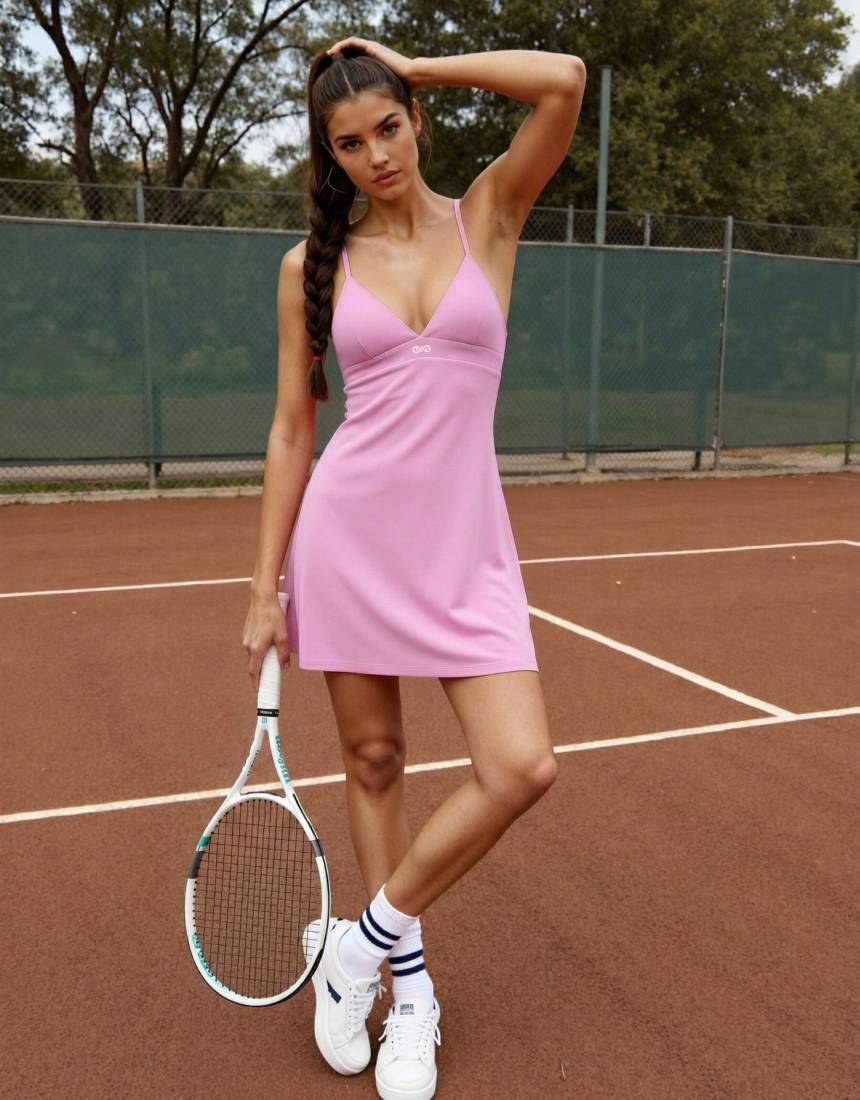
Wholesale cartons built to spec Presentation matched to your channel Packaging options by channel
- Ecommerce and DTC - branded polybags or mailer-ready boxes, tissue wrapping, product information cards, return-ready presentation.
- Retail and department stores - high-density hangtags, price-tag attachment, barcodes, size stickers and shelf-ready folding.
- Wholesale and distribution - individually bagged units inside custom-sized master cartons with your shipping marks and carton counts.
- Marketplace fulfilment - FNSKU or ASIN labelling, polybag warnings and packing to the centre's intake specification.
- Basic and eco options - plain or recycled polybags with minimal labels where packaging cost has to stay lean.
What goes on and in the pack
Beyond the bag or box, we can add woven main labels, printed size labels, care and content labels written to your market's requirements, woven or printed hangtags, and product information sheets covering fabric composition, care and sizing. All of it carries your brand, never ours. Because we develop packaging alongside the sample, you approve the real physical presentation rather than a digital mock-up.
Keeping packaging cost sensible
Packaging is a volume-cost item like any other: printed polybags and custom cartons have minimum quantities, while stock polybags plus a custom hangtag is a cheaper route to a branded look for a first order. We will tell you the cost difference between the two rather than assuming you want the full unboxing set, and for a trial collection we normally recommend keeping packaging simple and upgrading once sell-through is proven.
Send your channel and any retailer or fulfilment-centre spec with the order, and confirm packaging at sampling so nothing has to be reworked after production.Read more about our packaging and value-added services or ask our team for two packaging options at different cost points.
- What is the best fabric for high-performance activewear?Sep 24,2026
There is no single best fabric - the strongest base is moisture-wicking polyester with spandex for stretch, plus breathable nylon or mesh for ventilation. The right choice then comes down to weight, knit and support level, matched to the activity. We help brands pick the combination that performs for the wearer and holds up through industrial wash, instead of copying a competitor's spec sheet.
Polyester base for sweat transport Power knit with 4-way stretch 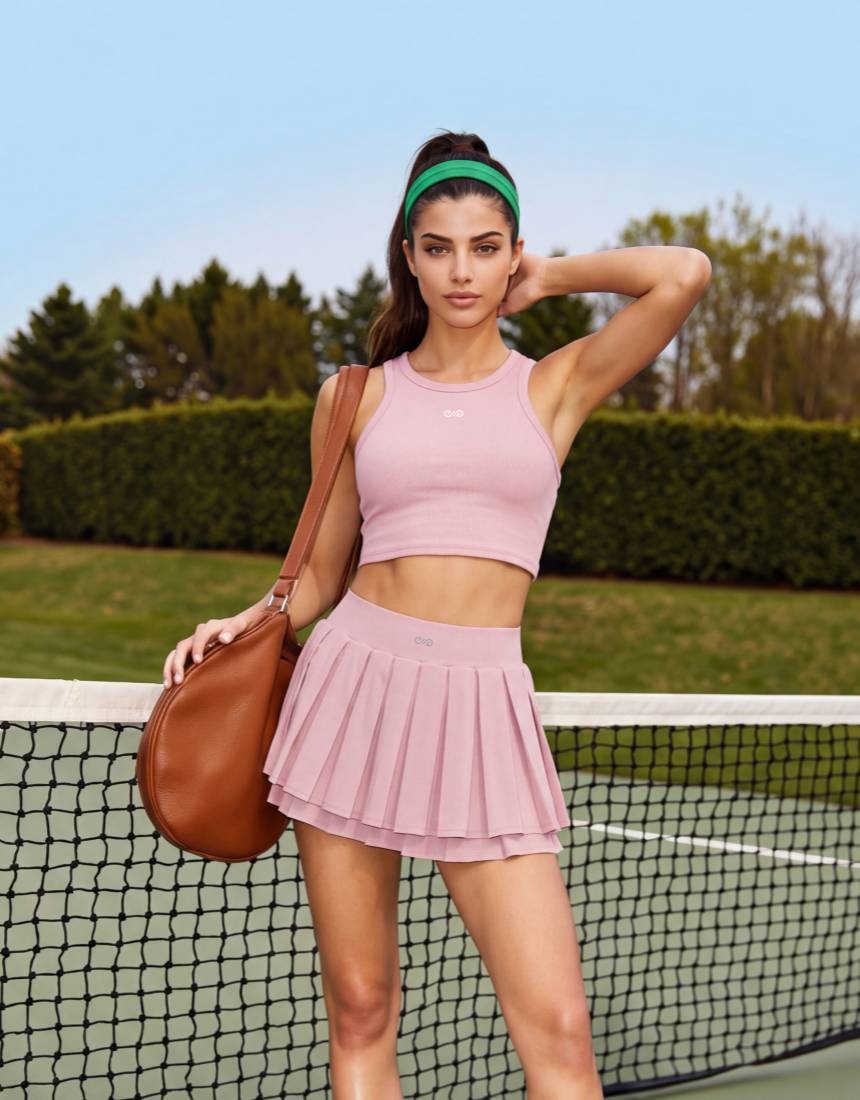
Light mesh for high-heat zones The performance base
- Polyester for wicking - moves sweat to the surface and dries fast, the foundation of most training tops and leggings.
- Spandex for stretch - 4-way recovery so the garment returns to shape after every wear and wash.
- Nylon for durability - resists abrasion where thighs, straps and seams take the most friction.
- Mesh for breathability - open knits in heat zones without adding weight.
- Power knit for compression - higher spandex content and firmed structure for support garments.
Matching fabric to activity
Low-impact styles like yoga and Pilates suit a softer nylon-spandex blend with a gentle handfeel. High-intensity training needs a lighter polyester mesh that dumps heat fast. Compression leggings use a power knit with 20-25% spandex for muscle support and opacity under stretch. Outdoor and transitional layers add a brushed back for warmth. The same silhouette can be offered in two fabrics so a brand covers both studio and street from one pattern.
Weight and handfeel decisions
Fabric weight, measured in grams per square metre, is the lever most brands under-use. A 180-220 gsm knit reads as premium and opaque for leggings; 130-160 gsm keeps a training tee light. We confirm weight at sampling alongside colour and stretch, and we can print, sublimate or bond the surface to change the look without changing the performance. That is how a single base fabric supports a whole collection.
Building a performance line? Tell us the activity, climate and target price and we will specify the fabric weight, composition and finish.Read more about our fabric development or send your performance brief for a recommendation.
- Can you handle large volume orders for sportswear?Sep 24,2026
Yes. We have the capacity to handle large volume orders and can scale production to meet demand without compromising quality or delivery. Our two factories cover a combined 20,000 m² and produce 500,000 pieces per month, supported by more than 1,000 employees. Volume for us is a scheduling question, not a threshold we have to check whether we can cross.
500,000 pieces produced monthly Volume scheduled, not squeezed Large runs of core activewear What supports high volume
- Two production sites - capacity is spread across facilities, so one line going down does not stop your order.
- Smart hanging lines - automated garment movement with output recorded per line, per style, per shift.
- Material depth - 200+ fabrics held, with supplied buffers for core programmes so fabric does not become the bottleneck.
- Dedicated line allocation - large runs get their own lines and a project manager rather than sharing queue position.
- Consistent inspection - AQL 1.5 across 8 rounds of checking, applied per batch at volume exactly as at trial scale.
Why volume does not dilute quality here
Scaling usually goes wrong when inspection is treated as a final gate - by the time 40,000 pieces are packed, a defect found at the end is expensive. We inspect in-line, so each batch is checked as it moves and problems are corrected before they multiply. Colour is verified under a light box per dye lot, and needle detection runs before packing. The monthly output of 500,000 pieces is what allows a large order to be spread sensibly rather than compressed into a rushed run.
How to scale an existing style
If you already produce with us, growing volume is straightforward: the pattern, construction file and fabric specification are locked, so an expanded order reuses the approved sample as its quality reference. If you are moving a programme to us from another supplier, we start with a counter-sample against your existing garment to prove the fit and handfeel match before committing to volume.
Our largest clients order in the tens of thousands of pieces per release. For a volume quote, send your style list and annual forecast and we will confirm capacity and lead time together.Read more about our factories or contact our team with your volume requirement.
- What is your policy for returns and exchanges?Sep 24,2026
We stand behind what we make - defective items can be returned or exchanged within 30 days of receipt. Because every order is custom-made to your specification, returns are handled as a quality case rather than a change-of-mind refund, and the process starts by identifying what went wrong so it is fixed at the source, not just on your single shipment.
AQL 1.5 catches faults early Root cause found on the floor Goods arrive as approved How a return or exchange works
- Raise it within 30 days - contact your account manager from the date goods are received.
- Send photos and details - images of the defect plus the style, size and quantity affected.
- We assess the cause - check against the approved sample and production records to find the root issue.
- Remedy arranged - replacement, repair or credit applied to your account as agreed.
- Process improvement - the finding feeds back into production so the same fault does not repeat.
What counts as a defect
A defect is a deviation from your approved sample - a seam failure, a wrong colour against the master, a fabric fault, a misapplied label or damage in transit that is our responsibility. Normal wear, incorrect care or a change of mind after approval is outside the policy, since custom production is built to the spec you signed off. Being clear about the boundary upfront keeps the process fast and fair for both sides.
Prevention is the real policy
Most issues are caught long before they reach you. Final AQL 1.5 inspection, per-batch colour and measurement checks, and weekly production reports mean a fault is usually found on the floor, not in your warehouse. The 30-day window is the backstop, not the front line - the goal is that you rarely need it. If a problem does appear, the production records behind your order let us resolve it quickly and prove what happened.
Received something not matching your approved sample? Send photos to your account manager within 30 days and we will open the case immediately.Read more about our quality commitment or contact your account manager to raise an issue.
- Do you support private labeling for activewear?Sep 24,2026
Yes, we offer full private labeling for activewear - custom logos, labels and packaging, so nothing on the garment or its packing carries our name. Everything a buyer sees at unboxing is yours: the neck label, the care instructions, the hangtag, the polybag and the carton. That is the standard for brands selling DTC, on marketplaces, or through retail where a competing supplier's name on a label would be unacceptable.
Your label, your packaging, no ours Woven main and care labels Branding applied across categories What private labeling includes
- Woven and printed main labels - your brand name and logo in the format and position you specify.
- Neck and size labels - printed heat-transfer labels for a smooth, tagless finish if you prefer.
- Care and content labels - fibre composition, wash instructions and origin wording compliant with your destination market.
- Branded decoration - logo printing, embroidery or silicone patches on the garment itself.
- Packaging and retail presentation - hangtags, polybags, tissue wrap and cartons carrying your branding.
What stays invisible
We do not print our factory name, code or contact details on your labels or packaging, and we do not display your developments in public showrooms. Designs, patterns and private moulds stay yours - we sign an NDA before tech packs or sketches are shared, and custom developments are not reused for other clients without your written authorisation. Your brand is the only identity that reaches your customer.
How to set it up
Private labeling is confirmed at the sampling stage: we produce the sample with your actual labels and decoration so you approve the real presentation, not a mock-up. Label artwork and wording are locked before bulk production begins, since label production runs ahead of garment assembly. If you are switching to private label mid-programme, we can also apply your branding to an existing style without changing the fit or fabric.
Selling into the EU, US or Australia? Tell us the destination and we will configure care-label content and packaging to match that market's requirements.Ready to put your label on your own line? Read more about our OEM and private label service or send your artwork to our team.
- What are your certifications for quality and sustainability?Sep 24,2026
We hold ISO 9001, BSCI, GRS and OEKO-TEX certifications, which together cover how we manage quality, treat workers, source recycled material and keep chemicals out of clothing. These are not wall plaques - they are the framework our production is audited against, and they are what let a brand put a credible certification claim on a label sold into the EU or US.
Audited to ISO 9001 and BSCI GRS and OEKO-TEX certified supply Standards run through the floor What each certification covers
- ISO 9001 - quality management system, the backbone of our process control and traceability.
- BSCI - social compliance audit covering labour, safety and workplace standards across the factory.
- GRS (Global Recycled Standard) - certifies recycled content and chain-of-custody for sustainable programmes.
- OEKO-TEX - verifies that textiles are free from harmful substances at every production stage.
- Documented for market access - certificates and batch records supplied for customs and retailer compliance.
Why it matters for your order
A certification is only useful if it reaches your customer's market with proof. Because we are audited against these standards, we can provide the documentation a retailer or marketplace requires - recycled content percentages, restricted-substance test results, social-compliance status - rather than asking you to source it yourself. For brands building a sustainable or premium positioning, that paper trail is often the difference between a launch that clears compliance and one that stalls at intake.
How certification links to daily production
These standards are not separate from the floor. ISO 9001 is the reason inspections are documented at eight checkpoints; GRS is why a recycled fabric is traceable to its mill; OEKO-TEX is why incoming materials are screened for restricted substances. The certificates summarise a discipline that runs through every order, which is why a certified factory tends to ship fewer surprises than an uncertified one with a lower quote.
Need a specific certificate or batch record for a shipment? Tell us the market and we will supply the documentation with the order.Read more about our certified production or ask our team for the certificates relevant to your market.
- Can I track my order once it’s shipped?Sep 24,2026
Yes. Tracking is shared the moment your goods leave Shenzhen, and you also receive production updates before shipment so there is no blind spot. Visibility starts at sample approval and continues until the cartons are in your hands - you are never guessing where the order stands.
Tracking shared after Shenzhen Weekly photo reports pre-ship Inspected before balance due What you get after shipping
- Tracking number - shared via our logistics partner once the booking is confirmed.
- Milestone updates - departure, arrival at transit hub, customs entry and final delivery status.
- Document copy - bill of lading or air waybill and packing list sent for your records.
- Single point of contact - your account manager owns the shipment update end to end.
- Exception alerts - any delay is raised proactively, not discovered at the deadline.
Visibility before the ship date
Tracking is only useful once the container moves, so the more valuable reporting happens earlier. While production runs on our smart hanging lines, your account manager sends weekly reports with live photos and video of cutting, sewing and final inspection. That means you see progress and catch any issue while it is still cheap to fix, then simply continue following the same order through to delivery with the tracking link.
Working with your own forwarder
If you manage freight yourself under FOB, we hand the goods and the paperwork to your nominated forwarder and share their tracking details the same way. Either route, you get a continuous thread from fabric to front door rather than a single update the day something ships. For multi-style programmes we track per style so you know which colourways are in transit.
Want updates on a tighter cadence during production? Ask your account manager for ad-hoc photo checks at any milestone.Read more about our production transparency or contact your account manager for your order's tracking.
- What are your terms for international shipping?Sep 24,2026
We ship worldwide, with FOB Shenzhen as our standard term and CIF, DDU or DDP available by arrangement. Goods leave from Shenzhen, one of the world's busiest export hubs, which keeps freight options and carrier competition strong. The right term depends on whether you want to control the ocean leg yourself or have us deliver closer to your door.
Goods leave from Shenzhen hub Cartons packed to spec Shipped to US, EU and AU Shipping terms we offer
- FOB Shenzhen (standard) - we deliver goods on board at Shenzhen; you manage the ocean freight and insurance.
- CIF - we arrange freight and insurance to your destination port.
- DDU / DDP - delivered to your warehouse or door, with duties handled (DDP) where the lane supports it.
- Air freight - available for urgent replenishments and small high-value runs.
- Door-to-door or port-to-port - chosen to match your logistics setup.
How cost is calculated
Freight is based on weight, volume, destination and the speed you need. Because cartons are packed to your garment dimensions, volumetric weight stays low and air freight stays sensible. We work with established freight forwarders and can quote both sea and air so you can balance cost against lead time. For recurring orders we can also consolidate shipments against your replenishment calendar instead of shipping ad hoc.
What we handle for you
Export documentation, packing lists and customs paperwork for the lane are prepared as part of the order, and we confirm incoterms and declared value with you before booking. If you have a preferred forwarder we work with them; if not, we propose one suited to your destination. The goal is a shipment that clears smoothly rather than one that sits in a port waiting on a missing form.
Not sure which incoterm fits your operation? Tell us whether you manage freight yourself and we will propose FOB, CIF or DDP.Read more about our export operation or send your destination and volume for a freight quote.
- What are the payment terms for orders?Sep 24,2026
We work mainly on T/T: a 50% deposit to start production, with the remaining 50% paid before shipment. This structure protects both sides - the deposit commits line capacity and materials, and the balance is cleared before goods leave Shenzhen. For qualified large-volume programmes we can also arrange a letter of credit.
T/T 50% deposit, 50% before ship Deposit reserves line capacity Terms flex for partners How the payment schedule runs
- Deposit (50%) - paid on order confirmation to reserve production lines and stage fabric and trims.
- Production window - sampling and bulk run on the scheduled dates once the deposit is received.
- Balance (50%) - settled before shipment, after final inspection and before the goods are released.
- Transparent milestones - you see the inspection result before the balance is due, so payment follows proof.
- L/C for large orders - letter of credit available for qualified high-volume or enterprise programmes.
Why this structure
A 50% deposit is standard for custom manufacturing because materials are cut to your specification and cannot be sold elsewhere - it covers the fabric, trims and line time committed to your order. The balance-before-shipment step means you pay only once the goods have passed final AQL inspection, so you are not settling for product you have not verified. For first-time partnerships this also keeps both sides' exposure limited while trust is built.
Options for established partners
Once we have a track record together, the terms can flex. Framework-agreement partners with reserved capacity often move to scheduled billing aligned to their forecast, and qualified large orders can use L/C where your finance team requires it. We will propose the arrangement that fits your order size and relationship rather than applying one rule to every client. Tell us your preferred method and we will confirm what your order qualifies for.
Prefer a different structure for a large programme? Ask about L/C or framework billing - we will match the terms to your volume and history.Read more about working with us or contact our team to confirm terms for your order.
- What makes Eationwear different from other manufacturers?Sep 24,2026
What sets us apart is the combination of flexibility, speed and certified scale: low-MOQ manufacturing, 7-10 day sampling and GRS and OEKO-TEX certified production, backed by two factories, more than 1,200 brand clients and OEM/ODM experience since 2009. Most suppliers force a choice between boutique attention and factory scale - we refuse that trade-off.
1,200+ brands served since 2009 Two factories, scalable capacity GRS and OEKO-TEX certified Flexible manufacturing
- Low minimums - start a collection at a flexible MOQ rather than committing to a warehouse-filling first order.
- OEM and ODM - hand us a finished tech pack or let us develop the style from a reference; both routes are supported.
- Private label ready - your labels, trims and packaging, with our name never on your product.
- Framework agreements - reserved capacity and stable pricing for long-term partners.
- Reorder continuity - the same fabric lot and construction file kept so a style stays identical across seasons.
Speed without losing control
Sampling runs in about 7-10 days and bulk in roughly 25 days after approval, but speed here is paired with visibility. Weekly production reports with live photos mean fast does not mean blind, and AQL 1.5 inspection across eight checkpoints means fast does not mean loose. For a brand testing a new drop, that combination - quick to sample, quick to scale, still fully inspected - is usually the practical edge over a slower或者 cheaper option that hides problems until shipping.
Scale you can trust
Two factories covering 20,000 m² with a monthly output of 500,000 pieces let us grow with you from first collection to enterprise programme without handing your work to a subcontractor. Certified sustainable production and 1,200+ brand clients served since 2009 are not just credentials - they are evidence that the flexibility and speed hold up at volume. The difference, in the end, is that we act like a manufacturing partner invested in your brand, not a warehouse that fills orders.
Comparing suppliers? Ask each one for their sampling time, inspection standard and whether your labels stay private - the answers separate a partner from a vendor.Read more about who we are or send your brief to see how we would approach your line.
- What customization options are available for activewear?Sep 24,2026
Customization covers branding, trims, packaging and the garment itself - logo printing, embroidery, labels, custom hardware and branded packaging, plus fit and fabric modifications. We build the full OEM/ODM scope around your brand rather than selling you a size chart to pick from. Our design team can start from a finished tech pack or from a reference garment, a competitor sample or a rough sketch, and will tell you honestly which changes affect cost and which are effectively free.
20+ finishes including heat transfer Branding applied to garment and pack Fabric and colour matched to your range Branding and decoration
- Printing - silk screen, heat transfer, digital print and sublimation, with 20+ finishes available across our lines.
- Embroidery and patches - logo embroidery, embossed silicone patches and woven badges positioned to your artwork.
- Labels - woven main labels, printed neck labels, size and care labels with the content your market legally requires.
- Hardware and trims - engraved metal aglets, branded zippers, custom-woven drawcords, silicone and rubber details.
- Packaging - polybags, boxes, tissue wrapping, hangtags and retail-ready presentation built for your sales channel.
Garment-level customization
Beyond decoration, we modify construction: fit adjustments and grading to your measurement chart, fabric substitution from our 200+ material library, colour matching against your Pantone reference, seam and hem changes, pocket and panel reconfiguration, and elastic or compression tuning for different support levels. Sports bras, leggings, hoodies, shorts, tanks and tees all run through the same customization process, so a collection can share branding and handfeel across categories.
How the process runs
You send the requirement; our design team returns a measurement sheet, material proposal and decoration placement for approval. Sampling then runs about 7 days, and the approved sample locks the specification into your production file. Because we cover OEM and ODM, you can hand over a complete design or ask us to develop the style from a mood board - most clients start with a hybrid, keeping their own silhouette and letting us solve the construction.
Tip: finalise artwork and label wording before sampling. Changes after the sample is approved invalidate the reference and restart the approval cycle.Send your tech pack or reference to our team for a customization proposal, or read more about our factory capabilities.
- How can I ensure the quality of my custom activewear?Sep 24,2026
Quality is checked at three levels - incoming material, in-line production and a final AQL 1.5 audit - across eight checkpoints from fabric to packed carton. The reason custom activewear holds up is that problems are caught while they are still cheap to fix, not discovered after 10,000 pieces are sealed. Your approved sample is the reference every checkpoint measures against.
Eight checkpoints from fabric to pack Seams checked during production Approved sample as the reference The three levels of control
- Raw material inspection - fabric weight, composition and colour checked on arrival, before any cutting.
- In-line quality control - seams, stitch density and measurements verified during sewing, batch by batch.
- Final AQL inspection - a statistical AQL 1.5 audit on the finished goods before they are packed.
- Colour verification - every dye lot checked under a light box against the approved master.
- Needle and metal detection - screening before packing to protect the end customer.
Why AQL 1.5, not a looser standard
AQL 1.5 is a tight acceptance limit, meaning very few defects are allowed in the sampled batch before the lot is rejected or reworked. We hold this across both trial and volume runs, so scaling an order does not mean loosening the net. The eight checkpoints spread the inspection through production rather than piling it at the end, which is what lets a large order be as consistent as a small one.
What you can do on your side
Your main lever is the approved sample: the clearer and more complete it is - fit, fabric, branding, packing - the tighter the reference every checkpoint checks against. Approve a counter-sample against an existing garment if you are moving a style to us, so fit and handfeel are proven before volume. From there, our weekly production reports show you the inspection results as the run advances, so quality is visible, not assumed.
Want tighter control on a premium line? Ask about inline reporting per batch and a copy of the final AQL report with your shipment.Read more about our quality process or send your style for a controlled production plan.
- What types of fabrics do you use for activewear?Sep 24,2026
We build activewear from performance synthetics - polyester, nylon and elastane - and from recycled options like RPET and recycled nylon. The right fabric is chosen per garment rather than applied uniformly, because a compression legging and a relaxed yoga top need completely different handfeel, stretch and recovery. Our library holds 200+ materials, so most requests are filled from stock rather than developed from scratch.
200+ materials sourced and held Knit and finish tuned per garment RPET and recycled nylon options Performance synthetics
- Polyester - the workhorse for moisture-wicking tops and outer layers, durable and colour-stable through repeated wash.
- Nylon - high abrasion resistance for leggings and shorts, with a smooth, premium surface.
- Spandex / elastane - 4-way stretch and recovery, blended in at 10-25% depending on the support level needed.
- Mesh and jacquard knits - breathable panels for high-heat zones and textured finishes for branding.
- French terry and fleece - brushed interiors for hoodies and loungewear where softness matters more than sweat transport.
Sustainable and recycled options
Every synthetic above has a recycled counterpart we can substitute without redesigning the garment. RPET (recycled polyester) and recycled nylon come from post-consumer and post-industrial waste, and we hold GRS-certified supply for brands that need traceable claims. Organic cotton and bio-based fibres are available for lower-intensity styles. Because we run GRS and OEKO-TEX certified production, a recycled claim on your label can be backed with mill documentation rather than a marketing line.
How the fabric gets chosen
You can specify the exact composition in your tech pack, or we propose it from the garment's purpose: support level, climate, wash cycle and price point. A high-intensity training set gets a lightweight wicking knit; a maternity or recovery line gets a softer, higher-stretch blend. Once a fabric is confirmed at sampling it is locked into your production file by name and lot, so a reorder six months later uses the same cloth, not an approximation.
Not sure which fabric fits your price and performance target? Send the use case and we will propose two or three options at different cost points from our 200+ library.Read more about our material capability or send your tech pack for a fabric proposal.
- What is the cancellation policy for wholesale apparel orders?Sep 24,2026
You can cancel within 3 days of payment. In that window the order is still in planning, fabric has not been committed to the cutting table and we can stop without cost to you. After the 3-day period, if the garments have already entered the production phase, a cancellation charge equivalent to 40% of the order value applies - that percentage reflects the mill orders already placed, fabric already cut and labour already scheduled on the line.
Fabric commitments start after order confirmation Line slots are reserved per order Branding produced against your artwork Why the 3-day window exists
Apparel production moves fast once it starts. Fabric is ordered against your order, dye lots are set, patterns are graded and a cutting slot is reserved. Three days is enough time for you to review final specifications, confirm colour approvals and raise any internal blockers before we commit material. After that point, costs are already incurred and cannot be recovered the way a stock item could be.
What counts as already in production
- Fabric committed - mill order placed, or stock fabric reserved and inspected for your order.
- Cutting started - the fabric has been spread and cut to your pattern, which makes it non-returnable.
- Line time booked - your style is scheduled into a sewing line, displacing other orders.
- Trims and branding produced - woven labels, hangtags or custom packaging already manufactured with your artwork.
If something goes wrong on our side
The cancellation charge protects against client-side changes, not manufacturing faults. If a defect is ours - wrong fabric, wrong measurement, failed inspection against the approved sample - we remake or credit the affected pieces instead of charging you, and we hold ourselves to AQL 1.5 with 8 rounds of inspection so issues are caught before packing rather than after arrival. The cleanest way to avoid the 40% scenario is a signed-off sample: once you approve it, production runs against that reference and there is nothing ambiguous left to cancel over.
Want to pause instead of cancel? If your launch date slips we can usually hold fabric and reschedule your line slot - talk to our team before the 3-day window closes and we will look at the options.Need the full commercial terms before ordering? Read more about how we work or ask our team for the order agreement with your quotation.
- Do you accommodate rush orders for wholesale apparel?Sep 24,2026
Yes, we accommodate rush orders - but the request has to be flagged when you place the production order, not after. Production scheduling is built from the orders already in the queue, so a rush requirement raised later can only be quoted against whatever line capacity happens to be left. Raised up front, we can reserve a cutting slot and a sewing line for your style from the start, which is what actually makes the shorter timeline possible. A rush fee calculated on a per-day basis applies to expedite processing, and we confirm both feasibility and cost before you approve anything.
Line slots reserved for rush orders Finishing processes scheduled to fit Packaging confirmed early to avoid delays Why timing of the request matters more than the fee
A normal bulk order runs about 25 days after sample approval. Compressing that means moving your style ahead of others in the queue, adding shifts, and in some cases sourcing fabric faster than the standard mill lead time. Every one of those levers has a cost and a limit, and both are easier to arrange at the quotation stage than two weeks into production. Tell us your drop date at the enquiry stage and we will quote the timeline and the rush fee together.
What we need from you for a realistic rush quote
- Your latest acceptable delivery date - the date the goods must leave Shenzhen, not the date you would prefer them.
- Quantity and style count - one style rushes more easily than six, and smaller volumes compress more safely.
- Fabric status - whether the fabric is already approved or still needs development, since that is often the true bottleneck.
- Branding and packaging readiness - label artwork and packaging confirmed early, so finishing does not become the delay.
- Sample approval - a signed-off sample is what unlocks the production start date.
How we protect quality when the clock is short
A rush order still passes the same inspection regime: AQL 1.5 across 8 rounds of checking, in-line and final. What we compress is scheduling and logistics, not the quality gates - if inspection fails, the pieces are reworked or remade, and that is true whether the order was rushed or not.
Best-case accelerated timeline: quotation within 24 hours, sampling in 7-10 days, then a compressed bulk run scheduled against current line capacity. Shipments leave from Shenzhen.Working to a fixed launch date? Read more about our production capacity or send your drop date to our team for a rush quote.
- Will you disclose our product designs to third parties?Sep 24,2026
No. We do not share, disclose or reveal any details of your product designs to third parties. Confidentiality is built into how we work: a non-disclosure agreement is signed before any tech pack, sketch or exclusive pattern is shared, and your developments remain yours alone. Your trust in that confidentiality is the foundation of a private-label partnership, and we protect it at every step.
Tech packs kept under NDA Your brand, never ours Access restricted to your team How we keep your designs confidential
- NDA before disclosure - signed before tech packs, sketches or exclusive fabric patterns change hands.
- No third-party sharing - your designs are never shown to other clients, suppliers beyond need, or public showrooms.
- Private moulds and patterns - custom developments are not reused for other clients without your written authorisation.
- Access control - development files are restricted to the team working on your order.
- Brand-neutral output - nothing we produce carries our name unless you ask; your brand is the only identity that reaches the customer.
What stays invisible to the market
Beyond the garment itself, the things that make your product yours - the pattern, the custom fabric, the trim, the fit - stay inside the partnership. We do not display your developments in public showrooms, and custom moulds or exclusive patterns developed for you are quarantined from other clients. If a supplier needs to see a component to produce it, that exposure is governed by the same confidentiality obligations, and only the minimum needed is shared.
Starting a confidential project
The cleanest path is to sign the NDA before sending your tech pack or reference garment, so protection is in place from the first conversation. From there, sampling and bulk run on the same confidential footing, and the approved sample plus production file stay locked to your brand. For brands moving sensitive or bestselling designs to us from another supplier, this front-loaded confidentiality is usually the deciding factor in the switch.
Want confidentiality in place before you share anything? Ask our team to send the NDA so your tech pack is protected from the first exchange.Read more about our partnership principles or contact us to put an NDA in place before sharing your designs.
- What is the minimum order quantity for apparel manufacturing services?Sep 24,2026
Our standard minimum order quantity is 300 pieces per design, and flexible MOQ is accepted for trial collections. That means you can launch a new activewear style with a small first run instead of committing to thousands of pieces before you know how the market responds. Because both of our factories run a combined 20,000 m² with a monthly output of 500,000 pieces, a 300-piece start is genuinely small for us - we are set up to absorb it without pushing you to over-order.
Both factories run 500,000 pieces per month 200+ fabrics available for small first runs Material sourcing tied to your MOQ How the 300-piece minimum works in practice
The 300 pieces apply per design, not per order. So a five-style capsule collection can start at 1,500 pieces in total, and you can size-grade that quantity across your full size range. The count is based on finished garments after inspection, and it is the same whether you order simple training tees or a constructed sports bra with bonded seams and moulded cups.
When we can go below the standard minimum
- Trial and test collections - first-season ranges for a brand entering a new category, where you need sell-through data before scaling.
- Sample and sales-man set orders - showroom pieces, trade-show samples and size sets ahead of a bulk commitment.
- Reorders on existing styles - once pattern, fabric and colour are locked, smaller replenishment runs are easier to slot into the line.
- Multi-colour or multi-print splits - we look at total volume per design when deciding what is workable, not volume per colourway.
What affects the minimum more than the number itself
Fabric choice is usually the real constraint. A stock fabric from our 200+ material library can support a smaller first run, while a custom-developed or custom-dyed fabric needs a mill minimum for the raw material, which pushes the garment minimum up. Custom hardware - moulded zippers, silicone prints, bespoke elastics - behaves the same way. If low volume is your priority, tell us at the enquiry stage and our team will steer you towards materials that keep the first order lean.
Practical sequence for a first order: send your tech pack and target quantity, we confirm a workable MOQ and fabric in the quotation, then sampling runs 7-10 days before bulk production of about 25 days. Shipments leave Shenzhen.Planning a trial collection? Read more about our factory or send your design to our team for a quotation with MOQ and pricing confirmed together.
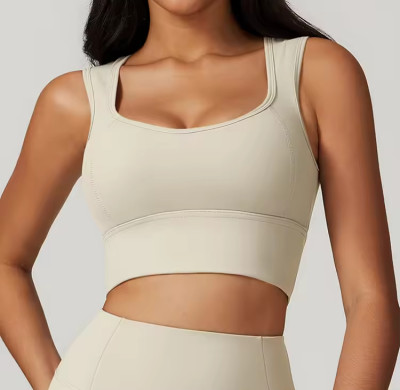
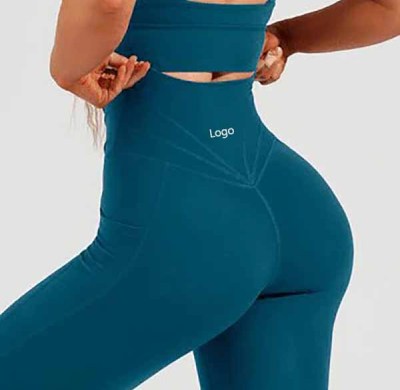
Are you looking for a reliable yoga sportswear manufacturer?
We can quickly provide customers with market analysis, technical support and customized services.Sign Up Out Newletter
- *Title
- *Content