Screen Print vs Sublimation for Sportswear: OEM Print Method Guide
Screen Print vs Sublimation for Sportswear: OEM Print Guide
"Should we screen print this or sublimate it?" is one of the most common questions we get at the sampling stage. Most brands treat it as a taste question. It is not. It is a technical decision where the fabric and the method lock each other in — and picking the wrong one does not cost you "a little quality." It costs you the run.
Last year an Australian fitness brand brought us a sample to diagnose. The previous factory (a competitor) had run a full-surface sublimated print on a cotton-poly fleece hoodie. At bulk, the artwork came out grey, the edges went white, and two washes made it look old. The print house did not do anything wrong. Sublimation only takes on fabric that is mostly polyester — with enough cotton in the blend, the disperse dye has nothing to bond to, so all you get is grey.
Here is the counterintuitive part we have learned running two facilities in Dongguan since 2014: the order of decisions is not "pick the artwork, then pick the method." It is lock the fabric first, then choose the print. Once the fabric is locked, you are usually down to one or two viable methods.
This is written for brand sourcing managers, product developers, and founders. We are a sportswear factory supplier doing OEM and ODM work, and the selection logic below comes from 1,200+ brand orders — not from a textbook.
The Five Ways Brands Get Print Selection Wrong
- Choosing the artwork before the fabric. Sublimation only works on polyester-dominant fabric (≥85%). Add cotton, and the print turns grey and washed-out.
- Screen printing a small order. Screen print needs one screen per color. On 200 pieces with four colors, the screen setup costs more than the printing itself.
- Not sublimating large color fields. Full-surface (all-over print) with multi-color gradients is exactly where sublimation has no setup cost and wins on price.
- Screen printing big solids on stretch fabric. On four-way stretch, a large solid print cracks the first time the garment stretches.
- Ignoring hand-feel and wash fastness. Thick plastisol feels stiff and is uncomfortable next-to-skin. If you skip fastness and cracking tests at sampling, you find out at bulk — when the whole run is already printed.
Choose Fabric First, Then the Method
The correct sequence is three steps: lock the fabric → choose the method → set the quantity and color count. Skip a step and you increase the odds that the sample looks fine while bulk fails.
1. Lock the fabric (this decides 80% of the choice)
| Fabric | First choice | Why |
|---|---|---|
| Polyester-dominant (≥85%) | Sublimation | Only here does disperse dye bond and stay |
| Cotton / cotton-poly blends | Screen print / heat transfer | Sublimation goes grey on cotton |
| Nylon / recycled nylon | Screen print / heat transfer | Sublimation takes unevenly |
| Four-way stretch (swim, compression) | Heat transfer / silicone / low-plastisol screen | Large solid screen prints crack |
2. Screen print — solid colors, mid-to-large runs, 1–4 colors
One screen per color, laid down one layer at a time. It gives the strongest coverage — you can print light on dark and it holds. The cost curve is screen count × color count: more colors costs more, and color count drives cost, not print area. Once the color count is fixed, the more pieces you run, the cheaper each one gets. It is the wrong tool for gradients, all-over prints, and tiny runs.
3. Sublimation — all-over and multi-color gradients, no setup cost
The artwork is printed onto transfer paper, then heat turns the disperse dye into gas that bonds into the polyester fiber. The print becomes part of the fabric rather than a layer on top. That means no setup fee, no hand-feel, and clean gradients. It is the default for all-over prints and team kits. The hard limit: polyester ≥85% only, and it favors light base fabric — on dark grounds you need a light base layer or the print shows white.
4. The fill-in methods: heat transfer, silicone, puff
For small runs, many colors, or a local logo, heat transfer works on nylon and blends; silicone and puff give a raised, dimensional logo but need care around stretch and washing.
5. The tests sampling must include
Wash fastness (laundering, rubbing, perspiration), a cracking test on stretch fabric, and a hand-feel check. All three belong at the sampling stage. Find a cracking problem at bulk and the only fix is reprinting the run.
How we take your print brief from here
- Send fabric and artwork. Give us the composition, GSM, and vector artwork. Within 48 hours we return a fabric-to-method feasibility note.
- Fix method and color count. We propose screen print, sublimation, or heat transfer with the color count and the cost logic behind it.
- Sample and test. We produce the print sample and run wash, rubbing, and cracking tests; both sides confirm before we seal it.
- Produce and inspect. Full run at AQL 1.5 with our 8-step check, shipped FOB Shenzhen.
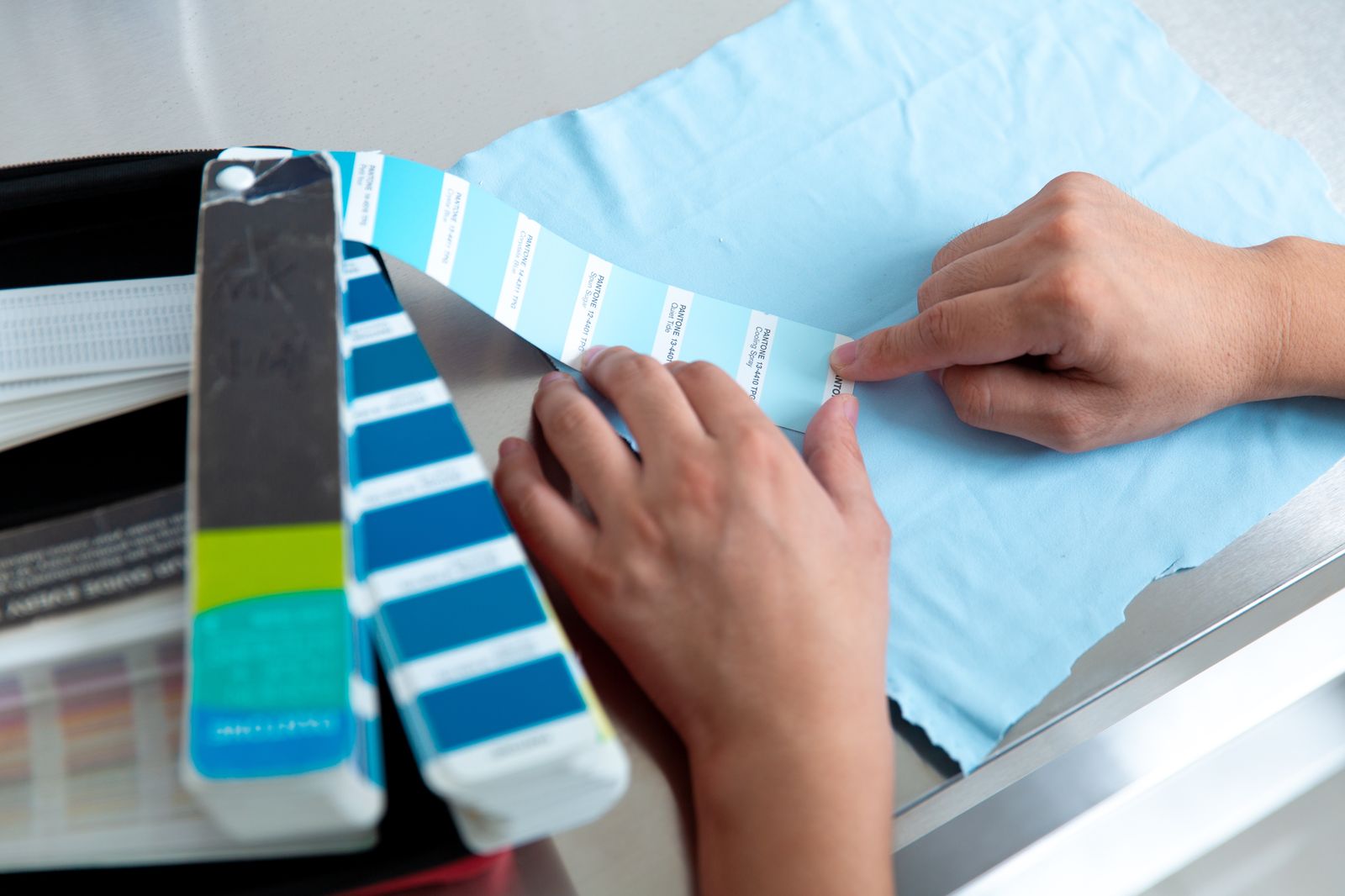
Screen Print vs Sublimation vs Heat Transfer
| Factor | Screen print | Sublimation | Heat transfer / silicone |
|---|---|---|---|
| Fabric fit | cotton, blends, poly | polyester ≥85% only | nylon, blends, local logo |
| Setup cost | yes — one screen per color | none | yes — tooling |
| Economic run | mid to large | small runs work too | small runs |
| Color count | cost rises per color | multi-color, gradients, no penalty | multi-color |
| All-over print | not suited | best fit | not suited |
| Hand-feel | thick ink feels stiff | none — dye bonds into fiber | depends on method |
| Light on dark | strongest coverage | needs light base | fair |
Questions Buyers Actually Ask
My fabric is a cotton-poly blend. Can I still sublimate?
Basically no. Sublimation relies on disperse dye turning to gas and bonding into polyester fiber. Once the cotton share is high, the dye has nothing to hold onto, so the print goes grey and fades further after washing. If the artwork needs many colors or gradients, we would move you to heat transfer, or switch the fabric to polyester ≥85%. This is a decision to settle when you choose the fabric, not after.
For a small run (200 pieces), which is cheaper?
Usually sublimation or heat transfer. Screen print needs one screen per color; spreading the screen setup across 200 pieces with four colors pushes the unit cost up fast. Unless the artwork is very few colors (1–2) and the fabric is cotton, small runs should favor a no-setup method.
What drives the cost of screen printing?
Color count, not print area. Every added color means another screen and another pass. So cutting five colors to three usually saves far more than shrinking the artwork. That is why we ask brands to control color count while the visual is still being designed.
Can you screen print on stretch fabric like swim or compression wear?
You can, carefully. A large solid screen print on four-way stretch cracks when the garment stretches. For big areas we recommend sublimation or heat transfer; for a local logo, silicone or a low-plastisol screen. Either way, we run a cracking test at the sampling stage.
I want light artwork on dark fabric. Which method?
Screen print has the strongest coverage, so light-on-dark is most reliable there. Sublimation on a dark ground needs a light base layer, or the print shows white. This shows up most on dark hoodies and dark leggings.
Does the print method change my MOQ?
Yes. MOQ 300 is the total-piece threshold, but screen setup changes the economic run — the more colors, the higher the piece count before it pays off. Sublimation has no setup, so the small-run threshold is lower. The print method directly shapes how your minimum order feels.
What does FOB Shenzhen mean — does it include freight?
FOB Shenzhen means free on board at Shenzhen port. We move the printed goods from Dongguan to Shenzhen, clear export customs, and load onto the vessel — everything up to that point is on us. Ocean freight and insurance from Shenzhen to your port are your side, or your forwarder's. The quote states the split plainly.
Send Us Your Fabric and Artwork
Send your fabric composition, GSM, and vector artwork. Within 48 hours we return a fabric-to-method feasibility note plus the color-count cost logic — so you know what your fabric can actually do before you design the print. Get the method right and bulk will not fail on you.
As a sportswear manufacturer operating in Dongguan since 2014, we would rather be a long-term partner than a one-order shop. If you are unsure which print method your fabric allows, ask. We will tell you straight. To see our print line first, visit our OEM print wear page.