

French Terry vs. Fleece: A Custom Hoodie Manufacturer's Fabric Guide
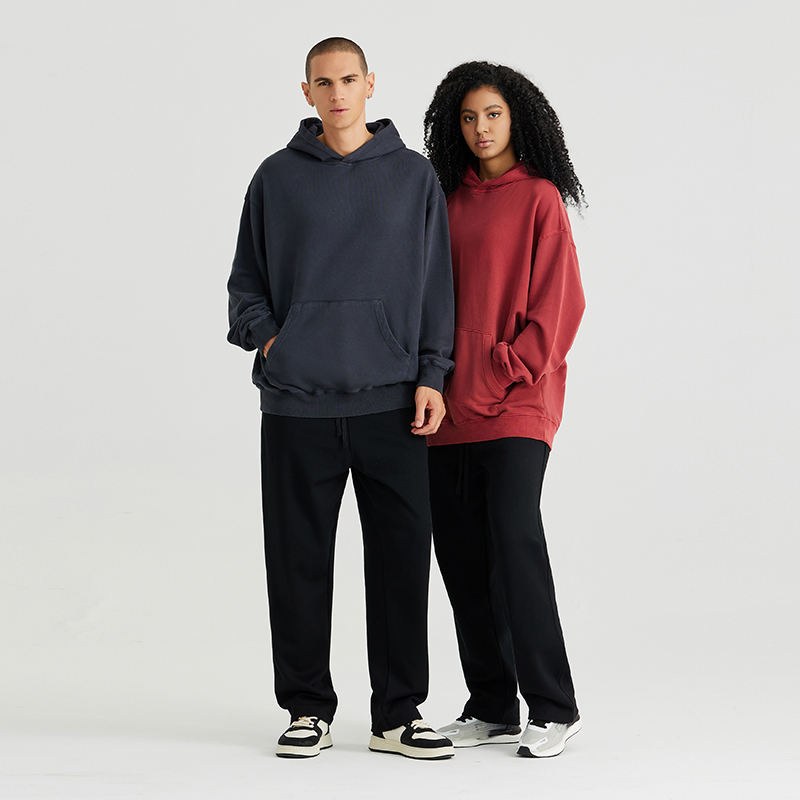
French terry and fleece is not a "which is better" question — it is a "which fits your use case" question. Lightweight layering and year-round styles go to terry; warmth-first fall/winter styles go to fleece.
- Structure — both are loopback knits with the same smooth face; the difference is all on the back: terry keeps unbrushed loops, fleece is brushed into a nap.
- Warmth — same GSM, fleece is warmer: the nap traps an air layer; terry breathes better and works year-round and indoors.
- Cost — fleece adds a brushing/finishing step, so same-GSM pricing runs slightly higher; the gap widens with weight.
- MOQ — both run our standard 300 pcs/style/color, flexible 100; fleece does not raise the floor, it only adds nap-standard work at sampling.
- Quality — pilling and shrinkage are fleece's two risk items; AQL 1.5 (major) with our 8-step inspection stays, plus in-line checks on weight and nap consistency.
Bottom line: write four things into the tech pack — fabric type (terry/fleece), GSM, nap direction, shrinkage tolerance — and both fabrics ship stable; writing only "fleece-lined" is where the classic pitfall starts.
From the fabric desk: where terry and fleece differ
Many buyers assume French terry and fleece are two completely different hoodie fabrics. They are actually two endpoints of the same knitting line. As a custom hoodie manufacturer, we start from the greige: the face of both fabrics is identical — a smooth jersey surface that takes prints and embroidery. The difference is entirely on the back. Off the loom, the back carries uncut loops; that is French terry. Brush those loops open, tease and finish them into a short nap, and you have fleece. So "fleece-lined" is not a fabric type — it is a finishing step. It changes hand feel, warmth and weight stability, not the garment's pattern structure.
That step is also why the word "fleece" alone is not enough in a tech pack: nap height, nap density, nap direction, pressed or unpressed — each one changes the finished hand feel. For how to pick the GSM number itself, see our GSM fabric-weight guide; this article does not repeat the number tables, it covers what changes when the same GSM goes terry versus fleece. It also layers against the private-label hoodie development line and the hoodie manufacturer selection basics — those cover the development process and how to choose a factory; this one covers how to specify the back of the fabric.
| Dimension | French Terry | Fleece |
|---|---|---|
| Back structure | unbrushed loops, smooth surface | brushed short nap |
| Warmth | moderate, better breathability | higher (traps an air layer) |
| Same-GSM price | lower | slightly higher (brushing/finishing step) |
| Hand feel | dry, crisp drape | soft, plush next-to-skin |
| Shrink & pilling risk | lower | higher (lock shrinkage and run pilling tests) |
| Season fit | year-round, indoor training, layering | fall/winter outerwear, warmth-first |
| Tech pack must-haves | fabric type + GSM + shrinkage | fabric type + GSM + shrinkage + nap direction |
When to spec French terry
Terry is the "clean structure" side. Four cases favor it: 1) year-round styles — better breathability than fleece, works as a single layer in spring/fall and as a layering piece in winter, with no season cutoff; 2) next-to-skin or base layers — the loopback is smooth, low friction on and off, and half the pilling worry; 3) big-logo and print-led styles — the smooth face is more stable for printing and embroidery, and facings like the placket and cuffs sew flatter; 4) streetwear that wants a crisp, structured drape — heavyweight terry hangs with more backbone than a nap. For private label hoodie programs, French terry is the default with the widest SKU coverage, and the steadiest bulk fabric on our hoodie manufacturing line.
When to spec fleece
Fleece pays for warmth and hand feel. Three buyer types should choose it: 1) fall/winter flagship styles — the nap locks an air layer against the body, a full warmth grade above terry at the same GSM, and it stands up to cold wind as an outer layer; 2) comfort-first next-to-skin programs — plush hand feel, chosen by brands whose core selling point is the first-second touch; 3) warm-up and outdoor layers — pre/post-training insulation and outdoor mid-layers are fleece's home ground. But fleece carries three extra management points: the brushing step, nap consistency, and shrinkage control. As a hoodie OEM we recommend writing nap direction, GSM tolerance and shrinkage into the tech pack alongside the fabric type — otherwise two bulk lots feel like two different fabrics, and the claims cost more than the fabric.
Cost & MOQ: the fleece account
Fleece adds a brushing/finishing pass over terry, so same-GSM pricing runs slightly higher, and the heavier the fabric the bigger that step's share — that is structural cost, not a factory markup. The MOQ does not move: both fabrics run our standard 300 pcs/style/color, flexible 100. What fleece adds is sampling workload, not a higher floor — archiving a nap reference sample, confirming GSM tolerance and running shrinkage tests all happen at the sampling stage, not in bulk. Fold in the order structure (split colors, multiple colorways) and the full math is in our sportswear manufacturer's MOQ guide.
Quality & AQL: shrinkage, pilling and nap consistency
Fleece's two quality risks are shrinkage and pilling. Shrinkage attacks fit — if a fleece program's shrinkage is not locked, bulk comes back a size under the sealed sample and the S–XXL grading drifts as a set; the standards for that are in our size grading and fit guide. Our practice is greige pre-shrinking plus a shrinkage tolerance locked at the sealed sample, with bulk accepted against that sample. Pilling is tested to the ASTM D3512 random tumble method (ASTM D3512 — an industry-standard test method, cited here as a standard fact only), and fleece adds a nap-consistency check: the same dye lot brushed twice can feel different, so we compare every lot against the nap reference sample. The inspection line itself does not change: AQL 1.5 (major) with our 8-step process, plus in-line checks at the weight and nap stations. For fabric safety and chemical compliance there is the OEKO-TEX Standard 100 system (OEKO-TEX Standard 100 — a third-party certification system, cited here as a certification fact only). For how to write the four tech-pack items line by line, the tech pack guide has the section-by-section template.
A growth-stage brand placed a fleece hoodie bulk with the tech pack reading just "brushed fleece" — no nap direction, no GSM tolerance, no shrinkage spec. The previous factory's first lot came back stiff, the second soft; two lots of the same style felt like different garments, and customers left reviews asking whether it was the same hoodie they bought last time.
After moving to us, the sealed-sample stage archived a nap reference, and the tech pack locked GSM to ±5%, shrinkage to ±1 cm, and nap direction to "one-way down the body." An 800-piece bulk was compared lot by lot and passed AQL 1.5 acceptance in one round. Same word, "fleece" — the difference is whether a string of measurable numbers follows it.
Print & decoration fit
Both fabrics share the same smooth jersey face, so the printing baseline is equal: screen print, digital print and embroidery all work; the differences are at the margins. Terry is dimensionally stable and flat, so large solids and all-over prints hold registration better. Thin fleece can let the nap re-assert itself through a print and slightly dull the edges; heavyweight fleece is actually steadier. Interior back printing — a design element on the inside of the garment — only works on terry; the brushed back of fleece has no printable flat surface. For the selection discipline among screen print, digital print and embroidery, see our print method guide — if your selling point is inside-detail design, terry is the only option.
Sampling & bulk timeline
Fleece adds one sampling step over terry: archiving the nap reference and confirming the shrinkage test, typically 1–2 extra days. With a complete tech pack and fabric in stock, the first sample lands in 7–10 working days, and bulk (300–3,000 pcs) runs about 25–35 days. Behind that timeline sits a combined 500,000 pcs/month across two plants (20,000 sqm, Dongguan + Guangxi), OEM/ODM since 2014, with peak-season orders shifted between the two plants rather than queued out. We ship FOB Shenzhen, with ocean or air transit added on top of the production window — the full period breakdown is in our production timeline guide.
Decision checklist: terry or fleece
The sections above, compressed into a checklist to run before you place the order — every decision point sits with the brand, not the factory:
- Year-round styles, next-to-skin layers, big-logo print programs — choose French terry: breathable, flat, the steadiest bulk fabric.
- Warmth-first fall/winter styles, comfort-first hand feel, warm-up insulation — choose fleece: one warmth grade up, plush next to skin.
- A fleece tech pack must carry four items: fabric type, GSM (with tolerance), nap direction, shrinkage — "fleece-lined" alone is where the pitfall starts.
- Pilling and shrinkage tests are confirmed at the sealed-sample stage; bulk is compared lot by lot against the nap reference and accepted at AQL 1.5.
- Both fabrics run MOQ 300/100 — fleece adds sampling workload, not a higher floor.
Lock fabric type and GSM: the use case picks terry or fleece, the number comes from the GSM guide — write the tolerance in.
Seal the nap at sampling: archive the nap reference, run shrinkage and pilling tests (ASTM D3512); first sample in 7–10 days.
Compare lot by lot in bulk: in-line checks at the weight and nap stations; acceptance at AQL 1.5 (major) with 8-step inspection.
Ship FOB Shenzhen: bulk 25–35 days; ocean/air transit counted separately.
About our line
Dual-plant (Dongguan + Guangxi, 20,000 sqm combined), 500,000 pcs/month, OEM/ODM since 2014, FOB Shenzhen. More facts on fabric, certification and capacity sit in our production timeline and print method guides.
Which is warmer, French terry or fleece?
Same GSM, fleece is warmer — the brushed nap traps an air layer against the body, a full grade above terry. Terry breathes better and works year-round and indoors. Warmth-first goes fleece; versatility goes terry.
Does fleece raise the MOQ?
No. Both fabrics run our standard 300 pcs/style/color, flexible 100. Fleece adds sampling workload — a nap reference sample and shrinkage testing — not a higher MOQ floor.
How do you control pilling and shrinkage?
Pilling is tested to ASTM D3512; shrinkage is controlled by greige pre-shrinking plus a tolerance locked at the sealed sample. Bulk is compared lot by lot against the nap reference, with GSM held to ±5%, accepted at AQL 1.5 (major) under our 8-step inspection.
Do the two fabrics print differently?
Both faces are smooth jersey, so screen print, digital print and embroidery all work. Terry is flatter and steadier for large solids; interior (back-side) printing only works on terry — fleece's brushed back has no printable flat surface.
What extra confirmation does fleece sampling need?
One more step: archiving the nap reference and confirming the shrinkage test, typically 1–2 extra days over terry. First sample in 7–10 working days; bulk of 300–3,000 pcs about 25–35 days, FOB Shenzhen.