MOQ for Custom Sportswear: How a Manufacturer Sets Minimum Order Quantities
MOQ is not a barrier a factory throws up to keep you out. It is the minimum economical volume that covers line changeovers, machine setup, dye-lot minimums and spread cutting waste. Treat volume and price as two separate levers, and small batches can still earn good terms.
- Why a factory sets an MOQ: every style change means re-tuning machines, re-planning production, a minimum dye lot, and spreading cutting waste. Below a certain volume the order simply loses money.
- Our sweet spot is 300 pieces. That volume just clears the changeover-loss threshold, letting you test the market small while we stay profitable.
- Unit cost falls as quantity rises, but the steepest drop is between 300 and 1,000 pieces; beyond 1,000 the marginal saving is small (illustrative range, confirmed per order).
- Three tactics to avoid rejection on small runs: mix styles to reach the MOQ, rolling re-orders, and standard stock fabrics. Each comes with the exact wording to use with a factory.
- Our baseline: MOQ 300 pieces, sampling 7-10 days, AQL 1.5 inspection with no shortcuts, FOB Shenzhen.
Tell us your category and projected volume, and within 48 hours we return a custom MOQ and tiered-pricing plan — contact us
1. What MOQ Is, and Why a Factory Must Set One
MOQ (Minimum Order Quantity) is often treated by buyers as “a barrier the factory likes to set.” From the factory side, it is a calculation. A garment moves through eight steps from order to shipment — pattern making, fabric sourcing, machine setup, cutting, sewing, finishing, QC and packing — and two of them, machine setup / line changeover and the minimum dye lot, are fixed costs. Whether you make 50 or 5,000 pieces, those two costs are almost identical.
Example: changing a print screen or re-setting a sewing template costs fixed labour and consumables; a dye house charges by the full lot. If the order is too small, those fixed costs spread onto each piece become absurdly high and the factory effectively pays you to take the clothes. So MOQ is fundamentally a break-even line, not a personal obstacle aimed at you.
Once you understand this, the negotiation changes: you are not asking the factory to “break the rules and discount” — you are working with it to find the volume that covers fixed cost without burying you in inventory. That is exactly where a mature buyer and a factory start to collaborate.
2. Why 300 Pieces Is Our Sweet Spot
We set MOQ at 300 pieces not by guesswork but by sitting right on the “changeover-loss threshold.” Below 300, fixed costs are not diluted enough and the unit price jumps; the factory also struggles to schedule the run. At 300 you just clear that hurdle, and both plants (20,000 m² combined, 1,000+ staff) can run their line and dye lots at efficient rates. What you get is the best value tier within small batches.
It is especially friendly for startups and the testing phase: 300 pieces is enough to spread across 3-5 SKUs for market validation without crushing your cash flow. When the data comes back, you talk about volume increases and price drops — the path is clear.
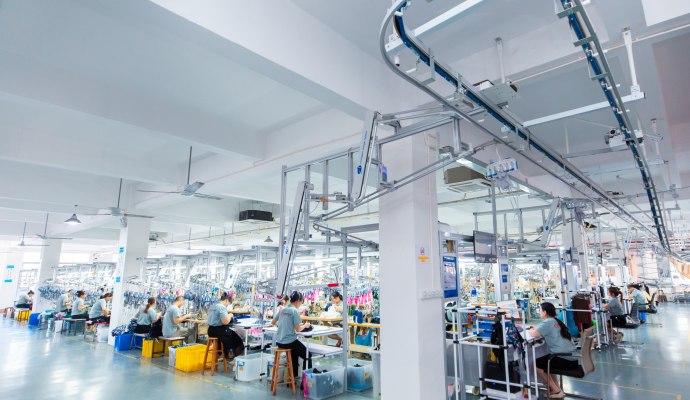
Eationwear sewing floor: an intelligent hanging line where a 300-piece run and a 3,000-piece run share the same QC system.
3. The Real Relationship Between MOQ and Unit Cost (mechanism, not a quote)
Unit cost falls as order quantity rises, but not linearly. Roughly: the biggest drop is from 300 to 500 pieces, it continues from 500 to 1,000 but the slope flattens, and beyond 1,000 to 3,000 the marginal gain is small. The table below is an illustrative range showing the trend only; the actual quote is confirmed per order:
| Order tier | Relative unit price (illustrative) | Best for |
|---|---|---|
| 300 pcs | Baseline 100% | Testing, first startup order |
| 500 pcs | ~90%-95% | Small-batch stocking |
| 1,000 pcs | ~80%-88% | Stable style, re-orders |
| 3,000 pcs+ | ~75%-82% | Mature bestseller, annual framework |
See the point? Moving volume from 300 to 1,000 pieces can lower the unit price by 12%-20%; pushing higher saves far less than people imagine. So do not blindly stock up “to get the big-order discount” — the 300-to-1,000 band is where the value is fattest.
4. Don't Get Rejected on Small Batches: Three Tactics
If you genuinely only need 300 or fewer yet want a good factory, these three tactics are the most effective we have seen:
- Mix styles to reach the MOQ: under the same fabric and process, combine 2-3 colours or styles into one 300-piece order. The factory's fixed cost is unchanged, but you get multiple SKUs in a small batch. Script: “These three styles use the same fleece — can we merge them into one MOQ?”
- Rolling re-orders: first order 300, but agree that a top-up within 60 days does not open a new MOQ. The factory gets the certainty of “continuous production” and is often willing to accept. Script: “First order is for testing; if it sells, I re-order within two weeks — can you lock the re-order price?”
- Standard stock fabrics: use the factory's existing patterns or stock fabrics (we offer 200+ fabrics, many stocked), skipping sampling and material prep so small orders schedule fast. Script: “Use your stock dropped-shoulder hoodie pattern, just change colour and print — can the MOQ come down?”
5. Trade a Lower MOQ With Projected Volume
If you have an annual plan, even if the first order is only 300 pieces, you can still negotiate: put the “total annual projected volume” on the table. The factory plans on full-year capacity occupancy; a smaller first order but a locked annual volume makes it willing to give on first-order price and MOQ. Three common plays:
- Annual framework price: sign an annual volume intent and the first order enjoys near-big-order pricing.
- VMI stock fabric: the factory stocks a certain fabric for you, you draw down weekly/monthly, and MOQ effectively vanishes.
- First order + re-order bundle: first 300 locked at re-order price, on condition of re-order within 90 days.
6. How MOQ Relates to Lead Time and Inspection (often misunderstood)
Many buyers worry “small batches get careless inspection.” The opposite is true: our AQL 1.5 plus 8-step QC is a unified standard across all orders; 300 pieces and 3,000 pieces go through the same QC flow, with no step skipped for smaller volume. On lead time, small batches can actually be faster because they don't wait for full bulk fabric — sampling 7-10 days, then production days calculated per order, not by a “big-order formula” that holds you back.
7. Where MOQ Differs by Category
MOQ is not one-size-fits-all; process complexity raises the floor. Basic hoodies (dropped shoulder, single-layer fabric) are easiest for small runs; tracksuits with lining have more process steps and size sets, so the MOQ is slightly higher at equal conditions; leggings demand four-needle six-thread machines and stretch fabric but have short per-piece time, so MOQ flexibility is actually larger. The mechanism: the more complex the process and the more size sets, the larger the volume needed to clear the threshold. For the optimal volume per category, this lead-time and scheduling guide explains the logic more clearly.
8. How to Negotiate MOQ With Us Most Profitably
The most effective inquiry is not “what is your MOQ,” but giving three things at once: category + first-order volume + projected volume (or re-order plan). We can return a custom plan within 48 hours — suggested MOQ, tiered price range, fastest lead time and inspection standard. Leave the uncertainty for us to absorb; put the certainty on the table, and the negotiation ends.
Also, if you are still stuck on “how to prepare a tech pack so the factory doesn't quote randomly,” this tech-pack guide helps you lock the acceptance standard, so even after negotiating MOQ down you won't fear quality surprises.
9. Three Common Buyer MOQ Myths
Myth 1: Only looking at the MOQ number, not the landed total. Many buyers open with “what's your MOQ,” feel 300 is high, yet never calculate the per-piece sellable cost. What really matters is “total investment for 300 pieces” and “price per piece,” not the MOQ itself. If a small order's unit price is 20% higher but you hold 70% less inventory, it may well be better for cash flow. We suggest treating the first order as “market-validation cost,” not “procurement” — once the mindset is right, MOQ stops being scary.
Myth 2: Assuming bigger volume is automatically much cheaper. The illustrative table earlier is clear: the steepest unit-price drop is 300 to 1,000; beyond 1,000 the marginal gain is small. Forcing 5,000 pieces to chase a lower price, then watching sell-through disappoint and the whole batch sit in the warehouse, loses more. Keeping volume in the sweet spot matters more than blindly chasing size.
Myth 3: Small orders dare not negotiate terms. Many startups feel “I'm only 300 pieces, the factory won't bother with me,” so they don't even raise re-orders. In fact the factory fears “small and uncertain” most; show a re-order plan or annual-framework intent and 300 pieces still negotiates a sincere price. The three tactics above (mixed styles, rolling re-orders, stock styles) exist precisely to break this deadlock.
10. How to Negotiate MOQ Together With Payment Terms
Order quantity and payment terms are a pair. The industry-standard rhythm is deposit plus balance in two stages (exact ratio confirmed per order; common is partial on order, balance before shipment). When you commit to larger total volume or faster re-orders, you can negotiate friendlier payment milestones — e.g. lower deposit ratio or later balance. The factory's willingness to give on payment is essentially trading “certainty” for “cash-flow safety.” Negotiate MOQ and payment as a package, not in isolation — you give visible annual orders, you get lighter cash pressure on the first order.
11. Buyer's MOQ Self-Check List
Run these five through before ordering to avoid 80% of the pitfalls:
- Is the first order in the 300-1,000 sweet spot — best value here, marginal gain collapses beyond.
- Did you give the factory the three-piece set: category + first-order volume + projected volume — miss one and they can't give a precise plan.
- Do you have a re-order or annual-framework plan to push the first-order price down — this is the ace for small-order negotiation.
- Did the small order use one of the three tactics: mix styles / rolling re-order / stock style — any one makes 300 easier to negotiate.
- Did you confirm the minimum per colour — we suggest no less than 80-100 pieces per colour, or changeover surcharges eat the margin.
Equip these five and send the inquiry — the plan you get will be ten times more professional than “what's your MOQ,” and the factory will show its sincere price.
12. What If the MOQ Changes: Top-Ups and Increases
Once the market moves, you will likely hit two MOQ-related situations. First, top-ups: same-style re-orders usually keep the first-order process, and MOQ can drop sharply or even be taken at replenishment volume, provided the pattern and fabric are unchanged and within the last material-prep cycle. Second, increases: when moving from 300 to 1,000 pieces, return to the tiered table earlier — this band drops price hardest and is worth planning for proactively. Both cases suggest locking fabric prep with the factory early to avoid the awkward “want to increase but waiting for material.”
Frequently Asked Questions
1. Do you take orders below 300 pieces?
Standard MOQ is 300 pieces. Below 300, use the “mix styles to reach MOQ” or “stock style” approaches above, depending on your category and fabric fit, confirmed per order.
2. Does MOQ include colour and size counts?
300 pieces usually means total pieces, splittable across colours/sizes, but a single colour too low (e.g. only 30 of one colour) may involve extra changeover and affect unit price; we suggest no less than 80-100 pieces per colour.
3. Is there still an MOQ on re-orders?
Same-style re-orders usually keep the first-order process; MOQ can drop sharply or even be taken at replenishment volume, provided pattern and fabric are unchanged. Depends on whether the fabric is still in the prep cycle.
4. Does custom printing raise the MOQ?
Printing itself does not raise MOQ, but special processes (e.g. embroidery, silicone) have minimum setup quantities. See the screen print vs sublimation guide.
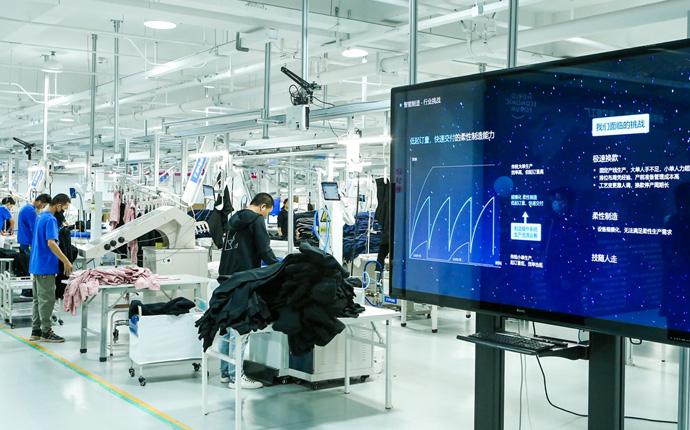
Eationwear owned plants: 20,000 m² combined, 500,000 pieces monthly capacity.
Want a MOQ and tiered-price plan tailored to you? Tell us your category and first-order volume — within 48 hours get a custom MOQ and pricing logic, no detours.