What Affects the Cost of Custom Sportswear Manufacturing?
A sportswear manufacturer does not pull a price from the air. A custom sportswear unit cost is built from four blocks: fabric, construction (make), decoration, and the volume tier. Fabric is usually the largest single block; construction complexity and decoration add labour and setup; and the volume curve decides how those fixed costs spread. Our standard bulk MOQ is 300 pcs per style per color, with first-order trial runs from 100 pcs per style per color, and reading the quote on one construction and compliance baseline is what keeps a price comparison honest.
Most buyers open a costing conversation with "how much per piece," then feel the number is a mystery. From the factory side it is not mysterious — it is an addition of four blocks. Before the sections below, hold the shape of the sportswear cost in your head: fabric + make + decoration + volume tier. Everything else is a modifier on one of those four.
- Fabric is the raw material: the GSM, the fibre blend, and how it is coloured.
- Make is the labour and machine time to turn fabric into a garment: panels, seams, and features.
- Decoration is what you put on the garment: print, embroidery, heat press, appliqué.
- Volume tier is the multiplier: the same garment costs less per piece as the run grows, because fixed costs spread.
Send us your category, target construction and first-order volume, and within 48 hours we return a line-by-line quote — contact us.
1. The Four Building Blocks of a Sportswear Manufacturer's Unit Cost
Every quote a sportswear manufacturer issues is the sum of the same four blocks — whether from an OEM manufacturing partner or a domestic cut-and-sew shop. Understanding them is what lets you read a quote instead of just receiving it. The table below is a typical anatomy for a mid-range legging or tee, not a fixed quote — the actual split moves with your spec.
| Cost block | What it covers | Typical share of unit cost |
|---|---|---|
| Fabric | Body cloth by the metre: GSM, fibre blend, dye method | 30% – 55% |
| Make (construction) | Cut, sew, seam type, panels, trims, finishing | 25% – 40% |
| Decoration | Logo, print, embroidery, heat press, placement | 5% – 20% |
| Volume tier | How fixed costs (setup, dye lot, spread-cut) spread per piece | the multiplier, not a block |
Notice fabric and make together are usually 60% – 90% of the unit cost. That is why a costing conversation should start with "what fabric and what construction," not "what is your price." For how we turn a spec into a locked cost baseline, see our tech-pack guide for sportswear manufacturers.
2. Fabric: The Largest Block, and the One Buyers Underestimate
Fabric is where most of the money and most of the variance live. Three choices move the fabric block the hardest:
- GSM (weight): a 220 GSM legging cloth costs more than a 160 GSM one, simply because there is more fibre per metre. Heavier, squat-proof fabrics for yoga and gym wear sit at the top of the range.
- Fibre blend: a nylon / spandex performance knit prices above a basic polyester / spandex one; recycled content (GRS-certified) carries a small premium but answers a real compliance ask.
- Dye method: solid piece-dye is the baseline; yarn-dyed and all-over sublimation add steps. Sublimation in particular is a print decision as much as a colour decision — our screen print vs sublimation guide lays out where each one saves or costs.
A common mistake is specifying "premium fabric" without a GSM or blend. That leaves the factory to pick, and the fabric block quietly swings 20% either way. Pin the cloth and the cost becomes predictable.
3. Construction Complexity: Where the Make Block Grows
The make block is labour and machine time, and it scales with how fiddly the garment is. A simple dropped-shoulder tee is cheap to make; a bonded-seam, multi-panel, lined sports bra is not. The levers:
- Panel count: more panels means more cutting, more sewing, more matching. A 6-panel tight costs more to make than a 2-panel one.
- Seam type: a flatlock (four-thread, flat) seam uses more thread and machine time than an overlock; a bonded (glue-film, seamless-look) seam replaces stitching with lamination and prices differently again. We do flatlock and bonded finishes, not Santoni circular-knit seamless.
- Trims and features: zippers, hidden pockets, mesh inserts, adjustable straps — each is a small labour add that compounds across a run.
The takeaway for costing: the tech pack is the cost. Every panel and feature you draw is a line on the make block. A tight, realistic tech pack is the cheapest thing you can do to control the sportswear cost.
4. Decoration: Small on the Garment, Big on Setup
Decoration is the smallest block by weight but the easiest to mis-budget, because most of its cost is setup, not per-piece. Three points:
- Screen print: low per-piece cost at volume, but each colour is a screen and a setup. A one-colour chest logo is cheap; a six-colour all-over is not.
- Sublimation: ideal for all-over, photo-grade colour, but it is printed as its own batch, so it carries a separate print minimum on top of the garment MOQ.
- Embroidery and silicone: premium look, higher setup and per-piece time; best reserved for hero pieces, not every SKU.
Decoration belongs in the costing conversation early, because the method you choose locks the setup before bulk. Our print-method guide shows how each behaves at bulk volume so you can cost it before committing.
5. The Volume Curve: How a Custom Sportswear Manufacturer Prices Scale
The volume tier is the multiplier, and it works through fixed-cost spreading. Below a certain run, setup, the minimum dye lot and spread-cutting waste sit on very few pieces and the unit cost is high. As the run grows, those fixed costs dilute. The steepest drop for a custom sportswear manufacturer sits between 300 and 1,000 pcs per style per color; beyond that the marginal saving flattens.
| Order volume (per style per color) | What it means for unit cost |
|---|---|
| 100 pcs (first-order trial) | Validates the market; unit cost sits at the trial tier. |
| 300 pcs (standard) | Just clears the changeover threshold — entry to efficient bulk pricing. |
| 300 – 1,000 pcs | The value band: the steepest unit-cost drop lives here. |
| 1,000 – 3,000 pcs | Further saving continues but flattens — diminishing return on volume. |
Our standard bulk MOQ is 300 pcs per style per color, and we accept first-order trial runs from 100 pcs per style per color so a new brand can validate before scaling. The exact MOQ mechanism and the value band are explained in our MOQ guide; for how volume tiers read inside a wholesale program, see our wholesale activewear guide.
6. How a Sportswear Manufacturer Reads Your Quote
A proper quote line breaks the sportswear cost into its parts so you can see what you are paying for. A typical line reads: fabric and make (per style per color), decoration such as print or heat press, packing and carton spec, and the FOB Shenzhen delivery point. What reaches you is not one mystery number but four visible blocks plus a shipping boundary.
Two things make a quote comparable across suppliers. First, align on the same construction — same panels, same seam type, same trims — because those drive the make block. Second, align on the same compliance baseline (BSCI, GRS, OEKO-TEX), because certified supply chains cost a little more and you should be comparing like with like. Our wholesale guide walks through reading a quote on one FOB boundary; our lead-time guide explains why the quote also implies a calendar, not just a price.
7. Hidden Cost Drivers Buyers Miss
Beyond the four blocks, five quiet drivers move the final number, and most are fixable on the brief:
- A vague tech pack: ambiguity forces a re-cut or a sample loop, and every loop is paid labour. A clear tech pack is the cheapest risk you can remove.
- Colour count: each colourway is its own dye lot and changeover, so spreading one style across eight colours costs more than concentrating on three.
- Size grading tolerance: holding tight tolerances across a wide size run needs more careful cutting and checking; our size chart and grading guide shows where the tolerance lives.
- Sampling: development samples run 7 – 10 days and are a separate cost from bulk; rushing them usually costs more, not less.
- Compliance: BSCI, GRS and OEKO-TEX add a small, defensible premium and protect you at the destination market.
Most "expensive" quotes are not expensive factories — they are vague briefs. Pin fabric, construction, colour count and compliance, and the sportswear cost stops moving after the first quote.
8. Getting the Best Price From a Custom Sportswear Manufacturer
Chasing the lowest number is the wrong game; getting the best price for your spec is the right one. Four levers work for small batch production without racing to the bottom:
- Standard stock fabrics: we hold 200+ functional knits in library, so most programs skip fabric development and its cost. Use a stock cloth and the make block is the only thing left to optimise.
- Mix styles to reach the MOQ: under the same fabric and process, combine 2 – 3 styles or colours into one 300 pcs per style per color order, so fixed costs spread across more sellable SKUs.
- Rolling re-orders: first order 300 pcs, then agree a top-up within 60 days does not open a new MOQ — the factory gets continuity and you get a steadier unit cost.
- Annual framework: put total projected volume on the table; a smaller first order backed by a locked annual plan often earns near-big-order pricing.
None of these asks the factory to lose money; they all give the factory the certainty that lets it price the make block efficiently. Details on the trial-MOQ and re-order mechanics are in our MOQ guide.
9. A Quick Buyer's Cost Self-Check
Run these five before you ask for a quote, and the number you get will be real instead of a placeholder:
- Did you pin GSM, fibre blend and dye method — or just say "premium fabric"?
- Did the tech pack state panel count, seam type and trims, so the make block is defined?
- Is decoration method chosen (print vs embroidery vs sublimation), with placement and count?
- Is the first-order volume in the 300 – 1,000 pcs per style per color value band, where unit cost drops hardest?
- Are construction and compliance aligned with any supplier you compare, so the prices are actually comparable?
Equip these five and send the inquiry — the quote you receive will be a unit cost breakdown you can defend, not a number you have to negotiate blind.
Does choosing a heavier or recycled fabric double the sportswear cost?
Rarely. Moving from a 160 GSM basic poly/spandex to a 220 GSM nylon/spandex might add 15% – 30% to the fabric block, and GRS recycled content a smaller premium still. Fabric is the largest block, so it moves the total the most — but "double" only happens if you also add bonded seams and all-over sublimation on top.
Does a bonded (seamless-look) seam cost more than a flatlock?
It prices differently rather than simply "more." Bonded finishing replaces stitching with film lamination, which needs its own equipment and process control; for some constructions it is comparable to flatlock, for others a step up. It is a make-block decision, not a decoration one, and it should be specced in the tech pack so the quote reflects it.
Why does a sportswear manufacturer with two plants quote more stably?
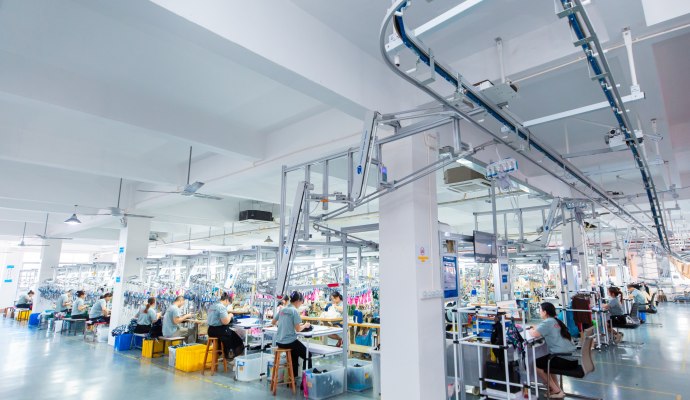
Two plants (20,000 m² combined, Dongguan + Guangxi) let fixed costs spread across more capacity and let us shift a run when one line is full, so volume-tier pricing holds steadier and lead time risk drops. Stable capacity is part of a stable unit cost.
How fast can I get a real, itemised quote?
With a clear category, target construction and first-order volume, we return a line-by-line quote within 48 hours. The faster the brief pins fabric, make, decoration and compliance, the less the sportswear cost drifts after the first number. Send the spec and we price it — request a quote.