




How to Choose a Sports Bra Manufacturer: Support, Seams & Size Grading
To choose a sports bra manufacturer, verify three build specs — support level, seam construction, and size grading — because none of them show in a photo sample.
- Support: match fabric and grade to impact (180–220 gsm nylon-spandex for low impact up to 260 gsm for high), not one bra for every activity.
- Seams: use flatlock 4-needle 6-thread or bonded joins where load concentrates; plain lockstitch fails under run-and-wash.
- Grading: grade multi-axis per cup and band, not a single S–XL scale stretched straight up.
- QC gate: inline checks (cup alignment, stitch density, hook security) plus final AQL 1.5 before shipment.
Bottom line: Audit the sports bra line on support, seams, and grading — the failures surface only when your customer runs, washes twice, or buys an L.
Support Comes From Structure, Not Thickness: Compression, Encapsulation, Composite Lockdown
First-time sports bra briefs usually say "good support," and the factory responds with thicker pads and heavier fabric - which brings bounce control, heat buildup, and a bulky silhouette, all at once. On the production floor, support comes from three structures: compression (elastic fabric pressing tissue toward the chest wall), encapsulation (each cup supporting independently, so the cup structure absorbs motion), and composite lockdown (underband, side wings and back construction working together to lock displacement).
High-impact styles use all three; low-impact may rely on compression alone. Ask a candidate factory one question: what structure carries your high-impact style? If the answer is "great stretch fabric" instead of "cup construction plus underband," you are talking to a yoga-top converter.
Grade Support First: Low, Medium and High Impact Are Three Different Process Packs
On our lines, sports bras split into three grades, each with its own process pack. Low impact (yoga / pilates): lighter gsm, soft or removable cups, no strong underband - comfort first. Medium impact (training / gym): heavier gsm, molded or laminated cups, wide underband, adjustable straps. High impact (running / HIIT): heat-molded cups, racerback or cross-back, widened elastic underband, wing compression.
The most common brand mistake is sending one style sketch with no impact grade - we sample it as low impact and you find it thin, we sample it as high impact and you find it stiff. Put the target sport and impact grade on line one of your spec; every downstream process decision hangs on it.
Why Flatlock Is the Baseline Seam for Sports Bras
Plain lockstitch is a hidden defect on a sports bra: seam bulk sits against the skin, chafes when you sweat, and snaps after repeated stretch. Flatlock (four-needle six-thread) butts two seam allowances into a flat interlock - almost no raised edge on the face, and it holds along the stretch direction. This is baseline construction for next-to-skin activewear, not a premium option.
How we allocate it: load-bearing seams (cup sides, underband, wings, back hook-and-eye tape) must be flatlock; no-show zones use bonded seamless lamination (film-bonded, no visible stitching); note that our "seamless" is bonded lamination, not Santoni circular-knit seamless - different equipment, different cost, so quote them separately. When you audit a counter sample, turn it inside out: flatlock flatness is visible at a glance.
Cups and Pads: Where the "Twisted Into a Ball After Two Washes" Problem Starts
Removable pads that migrate, fold, or escape through the neckline after washing are the single biggest source of one-star reviews in this category. The root cause is usually one of two things: pad lamination below standard (delaminates after a few washes), or lazy fixation (two tack stitches, or none).
Our three-tier approach: removable pads go into full-envelope pockets (covered top and bottom, so pads stay put and never overlap); fixed cups are heat-molded (one-piece, holds shape after washing); high-impact styles add molded cups plus wing reinforcement. When you write the spec, do not just say "with padding" - pad gsm, fixation method (full pocket vs tack), and removable or not are the three lines that decide what your customer says after a month of washing.
The Underband Does the Holding: Straps Fit, They Do Not Lift
Line talk: seventy percent of support is the underband, thirty percent is fabric. The underband is the structural member that actually locks displacement - it needs the right elastic specification, correct spandex orientation, and recovery after washing.
Straps exist to seat the cup against the breast shape, not to hoist it; designs that hang from the straps give you sore shoulders within two hours. Back construction follows impact grade: thin strappy backs for low impact, racerback or cross-back to distribute strap load for high impact, and a widened hook-and-eye tape set in flatlock. When you review a sample, do not stop at the front view - the back construction diagram is the support manual.
Size Grading: Single-Axis S-XL Is the Biggest Fit Trap in the Category
For casualwear, scaling S-XL on one axis is fine. A sports bra is a two-axis structure - underband plus cup volume - so single-axis scaling drifts everything: by the time you reach L, cup height, underband curvature and wing width are all off. Get the band right and the cup is shallow; get the cup right and the band is loose.
We grade on both axes: elastic recovery verified along the band, cup height and depth verified along the cup, with a wear test at each size step. Stretch fabrics add one more trap: linear scaling is not proportional support - a size L carries load differently from a size S even at identical construction. For how grading tolerance quietly destroys bulk consistency, see our size grading tolerance guide.
Fabric Matched to Impact Grade: GSM, Stretch Direction, Ventilation Zones
The same bra pattern may run 180-220 gsm nylon-spandex at low impact and need 260 gsm or above with high warp density at high impact - but gsm is only the surface. What matters is stretch direction and recovery: the underband runs horizontal-dominant elastic, cups run four-way stretch, and mesh ventilation zones sit at sweat lines (underarm, inner cup, back) rather than evenly everywhere.
Fabric acceptance is as strict as our yoga program: the mill test report must match the exact lot on your order, spandex deviation directly shortens recovery life, and recycled fibers need a GRS transaction certificate. Back hooks, strap sliders and other trims need salt-spray test reports - rusted hooks are the most avoidable complaint in bulk QC.
Logos That Survive Stretch: Placement Away From Structure
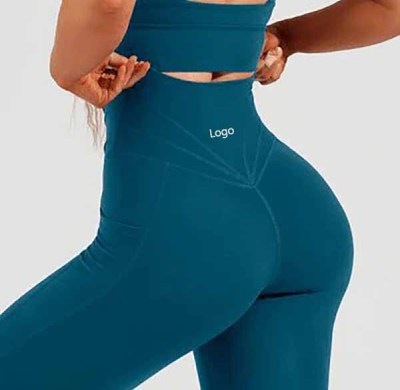
Logo placement on a sports bra is an engineering decision: silicone transfers and sublimation suit stretch fabrics, but the print position must avoid flatlock seams and high-stretch zones, or the logo cracks after a few washes - and your customer will not blame the print method, they will blame your quality.
A small chest mark in silicone transfer gives the best abrasion life; large graphics belong in low-stretch zones via sublimation. Print discipline decides bulk consistency - details in our print method guide.
How the Line Holds Bulk Consistency: Symmetry, Inline Checks, Final Audit
A sports bra tolerates asymmetry far less than a t-shirt: a left-right cup height difference, uneven strap lengths, or wing width mismatch is felt immediately on the body. The gates we run: cut-panel symmetry review, inline sewing checks (cup alignment, stitch density, hook security), final AQL 1.5 inspection (critical defects are stop-ship), and a pre-shipment audit.
Once the PP sample is approved it is sealed, and bulk is accepted against the sealed sample - the sample you sign in development is the acceptance standard on the floor. That is also why 48-hour sampling is a false economy: a speed sample that skips measurement passes your problems down to bulk. Sampling workflow and documentation are covered in our tech pack guide, and the production calendar behind lead times in our lead time guide.
Support in a sports bra is seventy percent underband and structure, thirty percent fabric weight. Audit the factory on three things - are load seams flatlock, are pads in full pockets, is grading dual-axis. Those three decide your return rate.
Sports Bra Spec Confirmation Checklist
Run this table before you sign off a sample - the left column is how most briefs read, the right column is the acceptance language we recommend in a tech pack. Brands who write it this way pass sampling in one round; the rest meet their problems at bulk and in reviews.
| Spec dimension | Typical brief | What to write in the tech pack |
|---|---|---|
| Support level | "High support" | low / medium / high + target sport scenario |
| Cup type | Sketch only | molded cup / removable pad / full-pocket fixation |
| Seams | "Flat seams" | flatlock on load seams + stitch density |
| Underband | Width on drawing | elastic spec + post-wash recovery rate |
| Straps | Default thin | width by impact grade + adjustable / non-slip |
| Back style | Front view only | racerback / strappy / cross-back + back construction view |
| Sizes | S-XL single axis | band + cup dual-axis grading, verified per size |
| Fabric | "High stretch" | gsm + spandex % + stretch direction, matched to grade |
This checklist is not about catching a bad factory - it is for you. Turn every vague expectation into a number someone can inspect, and both sampling loops and post-shipment complaints come down together.
How does MOQ work across multiple colors and sizes?
Our baseline is 300 pcs per style per color (the standard order for efficient production runs). One style in three colors means a 900-pc start; new customers may place a Flexible Order From 100 pcs to test the market (both first orders and reorders), not a rolling tier. Cup-size extensions do not count as new styles, but we recommend covering your core cup range first and adding edge sizes on re-orders. The full mechanism is in our MOQ and pricing guide.
Can you build high-impact styles? What do you need from us?
Yes. Development needs three inputs: target sport (running / gym / court), impact grade, and a reference style or sketch - we sample against the matching process pack. Heat-molded cups, racerbacks, widened underbands and flatlock load seams are all standard line capability here. We suggest entering at medium impact and stepping up to high: high-impact cup molds and scheduling are heavier, and sampling typically takes one extra round.
How do I stop pads from shifting or folding after washing?
Two root causes: pad lamination quality and fixation method. Our removable pads sit in full-envelope pockets (covered top and bottom - no migration, no overlap); fixed styles use heat-molded cups that hold shape after washing. Writing pad gsm and fixation into your spec is far cheaper than reworking bulk.
Do you make bonded seamless sports bras? Is that the same as seamless knit?
We produce bonded seamless construction (film-laminated, no visible stitching, smooth against the skin) - ideal for no-show panel joins and front cup surfaces. To be clear: this is not Santoni circular-knit seamless, which runs on different equipment with different yield and cost. We support full customization from moodboard to tech pack to PP sample, and white-label production of your existing styles.