How to Choose a Sportswear Manufacturer: A Sourcing & Audit Guide
Choosing a sportswear manufacturer is less about finding the cheapest quote and more about de-risking your bulk production. For established brands, the right OEM partner should clear four gates: verified certifications (BSCI / GRS / ISO 9001), proven bulk capacity, a documented quality system (AQL 1.5 plus multi-step QC), and airtight IP protection. This guide gives sourcing managers a practical, audit-first process to shortlist and qualify a sportswear factory — not a catalogue-browsing exercise.
1. Define Your Order Profile Before You Shortlist Any Manufacturer
Mature brands rarely fail because they picked the wrong factory — they fail because they briefed it wrong. Before you contact a single sportswear supplier, lock down three variables: monthly and annual volume, product mix (performance, athleisure, compression, outerwear), and the compliance bar your retail channel demands (recycled content, chemical restrictions, social audit grade). A manufacturer that is excellent at 200 gsm cotton fleece may be a poor fit for bonded seamless leggings, and a supplier built for 5,000-piece runs will treat your 300-piece test drop as a distraction rather than a relationship.
Write the order profile down and share it with every candidate up front. State the realistic annual volume, not the aspirational one; list the fabric bases and constructions you actually use; name the exact certifications your buyer or platform requires. This single document keeps the later conversation about capability, not cosmetics, and it lets a serious sportswear manufacturer tell you early whether they are the right fit — which saves both sides weeks of sampling theatre.
2. Shortlist Sportswear Manufacturers by Capability, Not Catalogue
A polished lookbook tells you almost nothing about bulk reliability. When you evaluate a sportswear factory, ask for the unglamorous evidence: the construction methods they run in-house (flatlock, bonded, seamless, sublimation, coverstitch), the size of their functional fabric library, and whether they do genuine custom development or only re-skin existing blocks. The best OEM partners for established brands act like an extension of your product team — they challenge your spec, propose a better stitch, and flag a fabric that will not survive wash testing — not a print-and-ship middleman that nods at everything.
Use the capability screen to disqualify early. If a supplier claims "all constructions" but cannot name the bonded adhesive they run, or shows a fabric library that is really three mills' catalogues, that is a signal. Established brands should shortlist three to five factories that demonstrably build the category you sell, then qualify them through the audit and capacity gates below rather than spreading RFQs across twenty unknown vendors.
3. Verify the Factory Audit: BSCI, ISO 9001 and GRS
For a brand shipping into the EU or North America, a social and quality audit is the price of entry. Look for a current BSCI report — Grade B or better signals a functioning management system, while Grade C or a report older than twelve months suggests a one-off cleanup rather than sustained control. ISO 9001 tells you the factory runs documented, repeatable processes instead of heroics; ask which procedures are actually certified, not just whether the certificate exists.
If you claim recycled content, GRS is non-negotiable, and the certificate alone is not enough: you need a valid chain of custody with transaction certificates at each stage from fibre to finished garment. Critically, verify the documents are real — cross-check the certificate number against the issuer database (e.g. the BSCI or Control Union portal) rather than trusting a PDF. A sportswear supplier that cannot show a valid, verifiable audit is a liability the moment a retailer or platform asks for proof. Read our breakdown of screen print vs sublimation and the process controls behind each to see why method discipline matters at scale.
4. Pressure-Test Production Capacity and Lead Time
Capacity is not a number on a website — it is a reality under peak-season load. Ask a prospective sportswear manufacturer how many pieces per month they actually ship, how they protect committed lead times during Q3–Q4, and what their contingency is when a fabric shipment slips. A credible supplier quotes lead time against a real production calendar, not a best-case guess, and can show you the calendar slots open for your season rather than promising "four weeks, always."
To pressure-test the claim, ask for two references from brands in your volume band and what their re-order rate is — a factory with happy one-time clients but no repeat business is hiding something. Probe the fabric pipeline: do they hold buffer stock of your base cloth, or does every order start with a fresh mill slot that breaks the moment a dye lot is late? See how we structure ours in the sportswear production lead time guide, which lays out the calendar logic behind a reliable delivery date.
5. Evaluate the Tech Pack and Sampling Process
The sampling stage is where bulk problems are caught cheaply or buried. A disciplined sportswear factory runs a structured tech-pack intake, confirms construction and tolerances before cutting, and returns a measured prototype — not just a photo. Expect a realistic sampling window of roughly 7–10 days for a developed style; a supplier offering 48-hour samples is usually skipping the measurement and material verification that protects your fit.
Use sampling to test the working relationship, not just the garment. Send a complete tech pack and see whether the factory asks intelligent questions or simply executes blindly. A good OEM will flag that your specified 220 gsm interlock will read heavy in a cropped silhouette, or that your seam allowance will not survive a flatlock at that tension. Our tech pack guide for sportswear brands covers exactly what to put in the file so sampling becomes a controlled step instead of a guessing game, and so the prototype you approve is the garment that ships.
6. Understand MOQ and the Pricing Structure
Minimum order quantity is only half the story; the other half is what actually drives your unit cost. For a custom sportswear manufacturer, price moves with fabric weight and composition, certification (GRS adds traceability cost, OEKO-TEX adds testing), colour count and placement, and order consolidation across styles. A factory that quotes one flat price per piece is either padding the quote or will surprise you with change orders later.
Understand the tiered logic before negotiating, and you can often hold margin without squeezing the factory. Consoliding several styles into one fabric buy, standardising trims, or committing to a repeat order in the same season are all levers that lower your effective cost per unit without asking the supplier to cut corners. The full mechanics are in our sportswear MOQ and pricing explainer, which breaks down how order structure — not just volume — shapes the number on your invoice.
7. Inspect the Quality System: AQL and In-Line QC
A mature brand should never discover a defect at the DC. Require a documented inspection plan: in-line checks during production, a final AQL 1.5 (or tighter for performance categories) on finished goods, and a clear pathway for corrective action. AQL 1.5 means the acceptable quality level tolerates roughly 1.5% of units with non-critical defects; in practice, for a lot of 2,000 pieces an inspector samples 125 units at General Inspection Level II and may accept the lot with zero critical defects, a tight ceiling on major defects, and only a small number of minor ones.
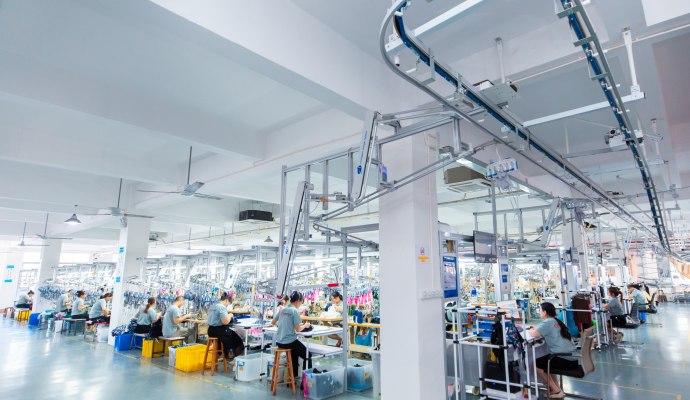
Defects are graded, and the grades matter. Critical defects — anything affecting safety or regulation — are zero-tolerance and trigger a stop-ship. Major defects affect function or visible appearance and are tightly capped. Minor defects are cosmetic and counted leniently. Ask how many inspection stages exist between fabric intake and carton: a serious sportswear supplier runs at least eight, from fabric inspection and colour approval through stitching audits, final audit and metal detection. The same discipline should extend to size grading tolerance across bulk runs, where inconsistent grading silently ruins fit quality at scale and is far harder to catch after the container leaves.
8. Check Fabric and Chemical Compliance for Your Market
Functional fabric is where performance and compliance meet. Verify the mill certificates behind claims like moisture management or four-way stretch, and confirm chemical compliance for your destination market. For the EU and North America, OEKO-TEX Standard 100 at Class I or II, REACH alignment on the SVHC candidate list, and fluorine-free DWR are now baseline for many retailers — not premium extras. GRS content must be backed by a transaction certificate, not a supplier's word.
A manufacturer that treats these as optional will become your recall risk the first time a buyer runs a third-party chemical test. Ask to see the actual mill test reports, not a summary, and confirm the certificate covers the exact fabric batch in your order. The print and fabric process guide shows how method choice interacts with compliance — a sublimation workflow, for instance, keeps chemicals out of the garment differently than a screen-print paste, and that difference shows up in your test results.
9. Assess Communication and IP Protection
For established brands, the biggest risk is not price — it is leakage. Before sharing a tech pack, confirm the sportswear manufacturer will sign an NDA that covers your designs, patterns and specifications, keep your files in a controlled environment with access logs, and never reuse your development for another client. Ask who inside the factory touches your drawings, whether version control is enforced, and what happens to your files when the project ends.
If a supplier hesitates on any of this, walk away. IP discipline is a culture, not a clause you staple on at the end. The factories that protect mature brands treat your tech pack like a bank handles a key — compartmentalised, logged, and never floating in a shared inbox. This is also where communication quality reveals itself: a partner that answers a spec question in hours with a named owner will protect your development far better than one that goes silent for a week and resurfaces with a finished copy of a competitor's style.
10. Run a Third-Party Inspection Before Bulk Release
Even with a strong audit, a pre-shipment independent inspection is cheap insurance on a large order. Book it against your AQL level with a recognised inspection firm, and write the result into the payment milestone so that a failed inspection blocks the final tranche rather than becoming a post-shipment argument. Tie the inspection to a defined sampling plan agreed before production, not one negotiated after the goods are boxed.
Treat a failed inspection as a stop-ship event — not a negotiation. The point of the gate is that it costs you one order to protect the brand, instead of shipping a container of marginal goods that a retailer rejects at the DC and pins on your label. This single step separates brands that scale from brands that get burned, and it is exactly the kind of discipline a serious sportswear manufacturer will welcome rather than resist.
11. Red Flags That Signal a Risky Sportswear Supplier
Watch for a consistent pattern of evasiveness. The most common disqualifiers are: no current audit document or one you cannot verify; vague or inflated capacity claims with no reference clients; refusal to sign an NDA or to describe file controls; inability to show a real bulk reference (only hero samples); pressure for a full 100% deposit up front; and deflection on chemical compliance. Any one of these should downgrade a manufacturer in your shortlist; two or more should remove it entirely.
Also trust the texture of the conversation. A supplier that cannot name its own QC stages, that quotes a lead time without a production calendar, or that agrees to every impossible spec without a single challenge is not confident — it is unaccountable. The right sportswear manufacturer pushes back on the things that would hurt your bulk run, because protecting the order is in its interest too.
The right sportswear manufacturer for an established brand is measured by what they can prove — audits, capacity under load, a documented quality system, and IP discipline — not by how good their catalogue looks.
12. A Practical Sportswear Sourcing Checklist
Before you commit, score every candidate against the same gates. The scorecard below turns the process above into a yes-or-no screen you can run in an afternoon and compare across factories without relying on memory or sales charm.
| Gate | What to verify | Pass bar |
|---|---|---|
| Certifications | BSCI, ISO 9001, and GRS if recycled | Current, verifiable in issuer database |
| Capacity | Stated monthly output and peak-season plan | Reference clients in your volume band |
| Quality system | AQL 1.5 plus multi-stage in-line QC | At least eight documented inspection stages |
| Sampling | Tech-pack intake and measured prototypes | 7–10 day window with graded feedback |
| Pricing | Tiered, transparent unit-cost logic | Breaks down fabric, cert and consolidation |
| Compliance | OEKO-TEX, REACH, fluorine-free DWR | Mill test reports for your batch |
| IP protection | Signed NDA and controlled file access | Named owners, version control, no reuse |
| Inspection | Pre-shipment independent check | Tied to payment milestone and stop-ship |
Run this list on three to five shortlisted factories, weight the gates by what your channel actually demands, and the decision becomes obvious instead of political. A manufacturer that clears every gate is worth a slightly higher unit cost than one that is cheap and fails three — because the cheap one invoices you twice: once in price, once in recalls, reworks and lost season.
What is a reasonable MOQ when sourcing sportswear?
For a custom sportswear manufacturer, a realistic minimum is around 300 pieces per style per colour, which keeps the line economically runnable while allowing a brand to test a range. Tiered pricing then rewards consolidation across styles and repeat orders, so the effective cost per unit drops as your programme matures rather than staying pinned at the opening quote.
How long does sportswear sampling take?
A developed style typically samples in 7–10 days once the tech pack is locked. Rushed sampling trades measurement discipline for speed — acceptable for a photo sample, risky for a production prototype, because the prototype you approve is the reference the bulk line is graded against.
Which certifications should I require from a sportswear factory?
At minimum, BSCI (social) and ISO 9001 (quality). Add GRS if you claim recycled content, and require OEKO-TEX Standard 100 / REACH alignment for chemical compliance in the EU and North America. Verify each certificate against the issuer database rather than accepting a PDF at face value.
Can a sportswear manufacturer protect my designs?
Yes — a professional OEM will sign an NDA, isolate your files, and prohibit reuse of your development. If a supplier will not commit to this in writing with named file owners and version control, treat it as a disqualifying risk for an established brand.