Leggings Quality Inspection: How a Leggings Manufacturer Builds an AQL Checklist That Catches Defects Before Bulk
Leggings QC is not "pull a carton and glance at it before shipping." What actually keeps bulk consistent is a three-layer gate: incoming inspection (fabric weight / colorfastness / recovery), in-line inspection (at every sewing station), and final AQL inspection. The failures that hurt most are not the obvious ones like a hole — they hide in size drift, skipped stitches, squat-show, pilling, and misaligned prints, the ones you check against a standard line by line. Whether you work with a leggings manufacturer or a custom leggings manufacturer, writing the tech pack as the acceptance baseline, locking tolerances, and asking for inspection records beats "we have strict QC" every time. When switching suppliers, the question is not "what's your AQL" — it is "which stations do you inspect in-line, and will you show me the final records."
Too many brands treat quality inspection as "once production is done, pull a few pieces and check for holes." That sentence alone misses 80% of the risk. What we handle on the QC desk is a different logic: leggings defects mostly hide where they "look fine" — one skipped stitch, 3% weaker waistband recovery, the second dye lot slightly more sheer than the first. This article is about how leggings quality inspection should be built so nothing slips: from AQL grading, to an 8-item defect checklist, to turning the tech pack into the acceptance baseline. If you are still choosing a factory, read our leggings manufacturer selection guide first; if you are wrestling with weight consistency, that is a different dimension — see GSM and batch consistency. This piece is only about inspection.
1. Why leggings quality inspection cannot rely on final inspection alone
Final inspection only (checking finished goods) puts all the risk on the last gate. Most leggings problems are buried mid-production: a cut piece is 5 mm off, the spandex recovery batch is unstable, the print is misaligned. By the time finished goods are sampled, the defect is already batch-wide. That is why we run a three-layer gate — incoming inspection catches the fabric at the source, in-line inspection (inline) intercepts at every sewing station, and final inspection only catches the remainder. A trustworthy sportswear manufacturer shows you all three layers, not just the phrase "AQL 2.5." Which stations get in-line checks directly decides how stable your bulk is — and it is one of the things we recommend you verify on-site during a factory audit.
2. What AQL 2.5 means: how critical / major / minor defects are graded
AQL (Acceptable Quality Limit) is the standard for sampling acceptance. For our leggings bulk we use AQL 2.5 (major defects). The key is grading — the same garment, different defects carry completely different weight:
| Defect level | Definition | Typical leggings example | Disposition |
|---|---|---|---|
| Critical | Affects safety / regulation / wearability | Loose zipper/hardware, allergenic dye, banned trims | 0 accepted, whole batch blocked |
| Major (AQL 2.5) | Clearly affects appearance/function | Skipped stitch, failed waistband recovery, squat-show, misaligned print, out-of-tolerance size | Accept/reject by sampling plan |
| Minor (AQL 4.0) | Barely affects use | Loose thread, minor stain, crooked label | Relaxed acceptance |
Many brands only ask "what's your AQL" but never define "which defect counts as major." The result: the same batch, factory A rejects as major, factory B passes as minor. So the standard must be written into the contract, not spoken. Side note: AQL only governs the pieces sampled, not the pieces not sampled — which is exactly why in-line inspection is needed to fill the gap.
3. The 8 most common leggings defects (one acceptance checklist)
This is the 8-item high-frequency list our two plants (Dongguan + Guangxi) actually check at final. You can copy it straight into your acceptance sheet:
| # | Defect | How to test | Acceptance line (reference) |
|---|---|---|---|
| 1 | Size drift | Lay flat, measure garment length / waist / inseam vs size chart & grading tolerance | ±1.5 cm (critical dimensions) |
| 2 | Skipped stitch / broken thread | Full visual check of every seam + stretch test | 0 accepted (major) |
| 3 | Squat-show (opacity) | Light-stretch test on dark and light colors separately | Light colors must be tested; no show-through |
| 4 | Waistband recovery | Stretch 3×, measure recovery | Recovery ≥ 90% |
| 5 | Pilling | Martindale or actual friction | ≥ grade 3–4 |
| 6 | Misaligned / fading print | Alignment + print-method matching fastness test | Alignment ≤ 3 mm, dry rub ≥ grade 4 |
| 7 | Color deviation / lot variance | Compare to standard under color-assessment light box | ΔE ≤ 1.5 (same lot) |
| 8 | Seam puckering | Check seam after sewing, laid flat | No obvious bulging accepted |
Of these 8, items 1/3/4/7 are the "looks OK but fails" danger zone — they are not obvious, but a customer wears them once or a batch ships and they surface. Whether you work with an OEM leggings manufacturer or a private label leggings manufacturer, this checklist belongs in your acceptance attachment.
4. Turn the tech pack into the acceptance baseline: the tech pack is the ruler for QC
The biggest QC pitfall is not "the factory doesn't inspect" — it is "there is no unified ruler." The same leggings: the pattern maker says 1 cm loose waist is fine, QC says no — because nothing was written into the development sheet. We keep stressing in our tech pack guide: size tolerance, weight tolerance, color-deviation ceiling, print alignment must be written in black and white into the tech pack — the tech pack is the acceptance baseline. Saying "per national standard" verbally is useless; national standards vary in leniency. Write the numbers and bulk can be checked accurately. The day the tech pack is finalized, 80% of the QC standard is actually set.
5. How bulk is inspected: in-line + final dual gate, plus wash test
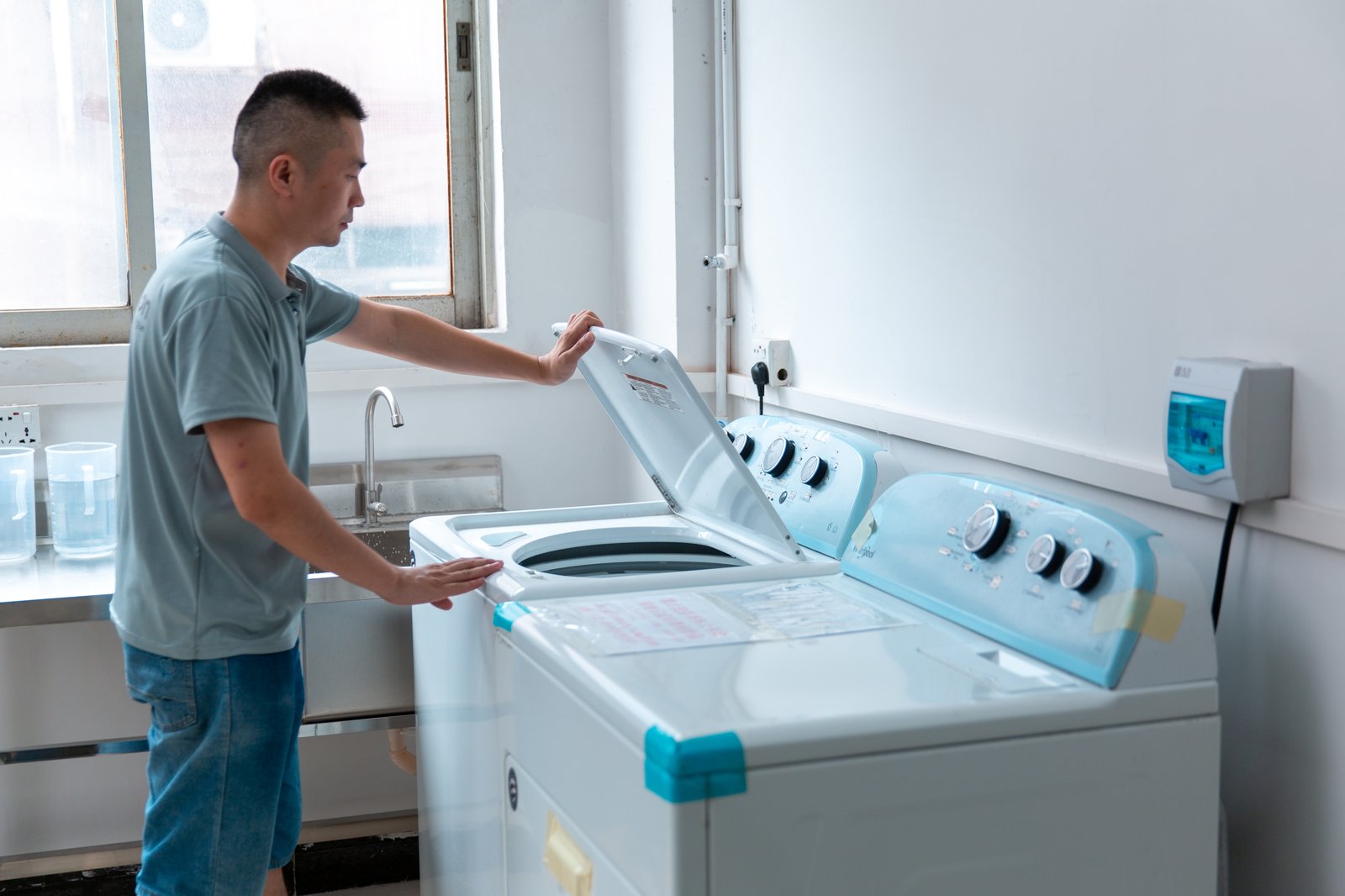
In execution, our bulk runs like this: ① Incoming inspection — every fabric lot sampled for weight, colorfastness, recovery (the same recovery metric we benchmark in our athletic wear manufacturer guide); rejected lots are not released to production; ② In-line inspection — sampling at every gate of cut / sew / print / press, problems sent back to the station the same day; ③ Final inspection — full 8-item check on AQL 2.5 sampling; ④ Wash / shrinkage test — sample pieces tracked for post-wash size and pilling (see below, a real test station). With four layers, batch consistency has a backbone. Note that both in-line and final eat into the lead time — QC is not free lunch, but what it saves is the freight and reputation of a whole rejected batch. Brands should do that math.
6. A supplier-switch case: the previous factory missed defects, here is how we closed the loop
A real story from an anonymous brand (kept anonymous at their request). Their previous supplier's leggings were fine on the first order, but the second batch drew concentrated complaints: same size with 2 cm waist variance, some squat-show, a few waistbands loosened after two washes. The root cause was not "sloppy workers" — that supplier only did final inspection, no in-line, and the tech pack had no tolerances written, so nothing intercepted mid-production. After switching to us, the first move was to complete their old tech pack with tolerances and write the 8 items into the acceptance attachment; bulk ran in-line + final dual gate, with inspection records per batch. From the third batch, complaints went to zero. This case is not to bash anyone — it is to show: the difference in QC is in the process, not the slogan. Whether a custom leggings manufacturer is worth trusting shows in whether they will lay their in-line stations and final records open to you.
7. Pre-sampling QC checklist: 5 things to lock first
- Acceptance standard written into the tech pack: size tolerance ±1.5 cm, weight tolerance, color ΔE, print alignment — in black and white, not verbal.
- AQL level + defect grading: confirm AQL 2.5 (major), and define which counts as major and which as critical, to avoid standard drift.
- Which stations get in-line inspection: require the factory to list sampling points for cut / sew / print / press — "we have final inspection" alone is not enough.
- Wash + pilling test: sample pieces for post-wash size and pilling tracking on bulk, especially light colors and compression styles.
- Inspection records archived per batch: final report, lot-variance data, inspection photos must be traceable for review and re-judgment.
With these five locked, talking MOQ and pricing finally makes sense. Standard bulk MOQ is 300 pcs per style per color; new customers can start with a 100 pcs per style per color trial order — and the trial order should still run the full three inspections, don't skip QC because the volume is small. Whether you work with a leggings manufacturer or a sportswear manufacturer, this checklist goes straight into your development flow.
The difference in QC is in the process, not the slogan. Three-layer gate (incoming, in-line, and final) + wash test, tolerances written dead into the tech pack, inspection records archived per batch — do these four and bulk leggings are stable. Asking a factory "what's your AQL" matters less than asking "which stations do you inspect in-line, and will you show me the final records."
What does AQL 2.5 mean?
AQL (Acceptable Quality Limit) is the standard for sampling acceptance. AQL 2.5 means the upper limit of acceptable defective rate for "major defects" is about 2.5%, judged by the sampling plan as accept/reject for the whole batch. But it only governs the sampled pieces, not the unsampled — which is why in-line inspection is needed to fill the gap.
Which items should leggings be checked against most?
The danger zone is the "looks OK but fails" items: size drift, skipped stitches, squat-show, waistband recovery, pilling, misaligned print, color/lot variance, seam puckering. Copy these 8 straight into your acceptance sheet and check against the acceptance lines in this article.
Is final inspection at shipping enough?
No. Final inspection only catches the remainder; problems are already buried mid-production. You need incoming + in-line + final three-layer gate, plus wash/pilling test, for batch consistency to hold.
How do I verify a factory actually does QC, not just talks?
Ask for three things: ① in-line sampling-point list (cut / sew / print / press); ② per-batch final report + inspection photos; ③ lot-variance and weight data. A trustworthy sportswear manufacturer lays these open to you, instead of just quoting "AQL 2.5."