Yoga Wear Manufacturer: Spec Pitfalls Most Brands Miss in OEM Development
In yoga wear development, the brand's most common failure isn't picking the wrong factory — it's a spec that omits a few critical dimensions: chasing "bare skin" feel without a recovery rate, drawing a high-waist line without addressing roll-down, a flat crotch seam that chafes, one size graded across XS to 3XL, and no wash-durability spec. These gaps hide in the sample and explode in bulk and after the first washes. Written from the QC desk of the factory that actually runs your order, this guide lays out the 7 most-missed spec items and shows exactly where we gate them.
"Bare skin" is a trap in yoga wear: support and recovery are the real metrics
We've taken plenty of overseas yoga brands where the sample felt like "nothing on," the owner loved it, then bulk dropped the GSM to chase a lower cost — knees and elbows bag on downward dog, it shows through on splits. Not a one-off. The brief wrote "bare skin / light" as the target but never wrote "recovery rate ≥ X percent after 100 percent stretch" or "no show-through at a defined stretch rate." Bare-skin is hand feel; recovery and opacity are function, and they are not the same thing. Ask the supplier for quantified recovery and opacity test data, not just GSM; the mill certificate for functional fabric must map to the exact cloth in your order, not a generic catalogue.
The waistband is not just looks: high-rise recovery and roll-down are top return drivers
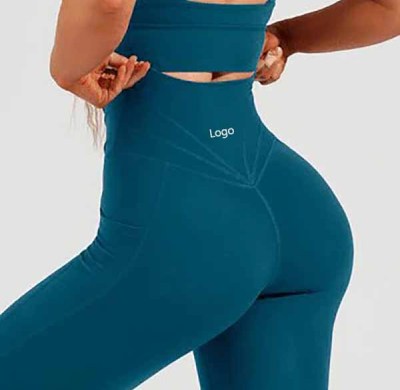
Yoga loads the waistband with repeated stretch far beyond daily pants — forward folds, inversions, downward dog. The returns we see most are not holes; they are the waistband sliding down after a few washes, or rolling and cutting into the skin. Brands draw a high-rise line but often omit "waistband recovery rate," "wide-band lining spec," and "no-roll tolerance after wash." We test the waistband's recovery after repeated stretch at sampling and hold it with a wide band plus a specific lining — these belong in the tech pack acceptance criteria, not a verbal "make it high-rise and non-rolling."
Gusset construction: why a flat crotch seam chafes
A lot of yoga pants chafe or bind in bulk because the crotch uses a flat panel instead of a gusset (triangular insert). Yoga opens the legs wide; a flat seam stacks fabric and rubs at the crotch. Brands drawing the pattern easily skip this — they give the outer outline but never mark the gusset. We require a triangular gusset on yoga pants and mark seam direction; it is the baseline craft of a close-fitting active bottom, not a premium option. The sample looks fine sitting down; it shows itself the moment it hits the mat.
Bonded seamless or sewn: which should your yoga wear use
Let's separate the terms first: our "seamless" is bonded seamless (film lamination, no visible stitches, smooth against skin), not Santoni circular-knit one-piece seamless knit — the two use completely different equipment, yield, and cost, so keep them apart when you ask. On yoga wear, bonded suits waistbands, side seams, and no-chafe joins — smooth, no friction points; flatlock 4-needle 6-thread suits seams that need strong support and wash endurance. "Seamless is always better" is wrong; the right call is by stress point. Brands should mark the process per seam in the tech pack, not a vague line that just says "seamless."
Size range and stretch: XS to 3XL is not one pattern
The high stretch of yoga wear makes many brands assume "scale one pattern up and down." But stretch ratio shifts with size: a small size stretched to 150 percent still fits; the same pattern at a large size may lose support at the hips first. We grade by size segment and check stretch and recovery per size, instead of linear scaling. Brands developing the whole range off a single sample size are a top source of fit complaints in bulk. On how grading tolerance quietly ruins bulk consistency, see our size grading tolerance guide.
Fabric intake: the mill report must match your actual batch
Functional fabric is where performance meets compliance. Many brands file the supplier's mill certificate PDF and never check whether it covers the dye lot and batch of your cloth. We inspect at fabric intake — GSM, composition, stretch direction, opacity — and keep a retained sample. Claiming recycled needs a GRS Transaction Certificate (TC); EU / North America chemical compliance needs OEKO-TEX Standard 100 / REACH alignment — these require the mill test report for your batch, not a generic summary. Authoritative entry points: OEKO-TEX official site and GRS / Textile Exchange.
Wash durability: still fitted after 50 washes is what makes real yoga wear
A crisp sample does not mean bulk survives washing. Yoga wear's high wash frequency plus repeated stretch makes "sags and goes sheer after a few washes" a silent return driver. Brands often omit the wash-durability spec (for example, recovery retention, no show-through, no deformation after 50 washes). We test and report against that spec instead of shipping only the fresh-garment state. Writing wash durability into acceptance matters far more than chasing a pretty sample — the former governs your customer's repurchase after three months; the latter only governs unboxing.
From sampling to bulk: the prototype you sign is the garment that ships
Sampling is where bulk problems get caught cheaply or buried. A disciplined factory runs a structured tech-pack intake, confirms process and tolerance before cutting, and returns a measured prototype — not just a photo. A mature style's sampling window is typically 7–10 days; a "48-hour sample" usually skipped the measurement and material verification that protect your fit. Our tech pack guide covers what belongs in the file so sampling stays controlled — the prototype you sign off is the reference for the bulk line's grading.
The 5 gates we hold for you through development
From your spec to carton, we hold at least 5 gates: fabric intake inspection, Pantone color confirmation, in-line sewing audit, finished-goods AQL 1.5 (tighter for performance), and pre-ship final inspection plus metal detection. AQL 1.5 means roughly 1.5 percent tolerance on non-critical defects; defects are graded — critical is zero-tolerance stop-ship, major is strict-capped, minor is loosely counted. A credible factory quotes lead times off a real production calendar with peak-season capacity planning; the calendar logic behind reliable delivery is in our production lead-time guide. Writing these gates into the cooperation terms beats checking after the fact.
Eighty percent of yoga wear development problems live in the brief, not the factory. Move recovery, opacity, waistband, gusset, seam choice and wash durability from "I assumed the factory would handle it" to "I wrote it into the tech pack," and your bulk will match your sample.
Brand-side yoga wear spec self-check
The table below is for the brand to self-check — turn "I assumed the factory would do it" into "I wrote it into the spec." A brief that fills these items line by line lowers both sampling rework and bulk complaints; the ones left blank are exactly the return categories we see after shipment.
| Spec dimension | What brands often omit | What to put in the tech pack |
|---|---|---|
| Recovery rate | Only writes "bare skin / light" | Recovery ≥ X% after 100% stretch |
| Opacity | Misses squat / opacity test | No show-through at defined stretch |
| Waistband | Only draws a high-rise line | Recovery rate + wide-band lining + no-roll tolerance |
| Crotch | Flat seam | Triangular gusset + seam direction |
| Seam choice | Vague "seamless" | bonded / flatlock per seam position |
| Size stretch | One size graded across range | Segmented grading + per-size stretch check |
| Wash durability | Misses wash spec | Recovery / opacity retention after 50 washes |
| Fabric batch | Keeps generic cert PDF | Mill report + GRS TC for this batch |
This checklist doesn't screen factories — it's for you. Turn each item from a vague expectation into an accepted number, and both sampling rounds and post-shipment complaints drop together.
Yoga sets and separates developed together — how is MOQ counted?
Our baseline is 300 pieces / per style per color (standard, for economical scheduling and style testing). A yoga set is usually top + bottom, counted as two styles, each with its own MOQ. New clients can run a 100-piece trial order (test the market) on the first order only — not a standing norm. Consolidating several styles into one fabric buy and committing to a repeat lowers unit cost rather than stopping at the opening price. The full mechanism is in our MOQ and pricing explainer.
Can yoga wear be printed / sublimated? Will it affect stretch?
Yes. Sublimation suits polyester-base yoga fabric — the artwork won't crack and won't block stretch; screen print works with the right elastic ink. Keep prints off high-stretch zones and choose elastic ink. Method discipline decides bulk stability — details in our print-method guide. Write print position and stretch requirements into the spec rather than arguing after.
Will yoga wear sag or go sheer after a few washes?
It depends on the recovery rate and the wash-durability spec. We write "recovery / opacity retention after 50 washes" into acceptance and test against it, instead of shipping only the fresh-garment state. Brands that omit this are the top source of silent post-wash returns — the customer who finds it sagging after two months blames the brand, not themselves.
Can you do bonded seamless yoga wear and custom development?
Yes. We run flatlock 4-needle 6-thread and bonded seamless (film lamination, no visible stitches, smooth against skin), and support full custom development from moodboard to tech pack to PP sample, plus white-label refreshes of existing styles, including yoga sets. Note: our "seamless" means bonded seamless, not Santoni circular-knit one-piece seamless knit; if you need the latter, confirm the supplier truly has that circular-knit capacity, because the equipment, yield, and cost are in a different league.