Private Label Activewear Manufacturer: From Tech Pack to Bulk Production
Turning a design into shippable bulk runs through 8 production gates, not just "pick a factory." What actually decides whether your lead time holds and your first-pass yield stays high is not how loud a factory's slogans are — it is the completeness of your tech pack and whether the PP sealed sample is locked. We run this line across our Dongguan + Guangxi dual plants: sampling 7–10 days, bulk scheduling after sealing, FOB Shenzhen. This is the real pipeline a Private Label Activewear Manufacturer uses to turn a drawing into goods — and it is a completely different job from "how to choose a factory," "how to negotiate MOQ," or "how to read cost."
Most brands spend their energy on "which factory" (see our manufacturer selection guide) and "what is the minimum" (see the MOQ guide) — both valid. But what actually sinks an order is rarely the factory choice; it is the production-line execution after the drawing reaches the factory that nobody explains clearly. Our private label starter guide covers what private label is and who it fits; this article skips concepts and only walks the 8 gates that actually happen on our line, and what you should deliver and confirm at each. Whether you work with a Custom Sportswear Manufacturer, an OEM Sportswear Manufacturer, or build your own Sportswear Product Development team, the gates below are the same.
- Gate 0 — Tech Pack intake
- Gate 1 — Pattern making and grading
- Gate 2 — Proto / SMS sample
- Gate 3 — PP sealed sample (contract sample)
- Gate 4 — Marker making and cutting
- Gate 5 — Sewing line balancing
- Gate 6 — Finishing and QC
- Gate 7 — Packing and FOB Shenzhen shipment
1. Gate 0 — Tech Pack intake: completeness decides every later efficiency
A usable tech pack needs at least five things: the construction spec, the size chart with tolerances, the fabric and trim bill (with composition and GSM), the placement sheet (logo / print positions), and the packing instruction. Miss any one and production has to guess for you — and guessing is the only source that triggers a rework loop. The first move after we receive a tech pack is not scheduling; it is a design-for-manufacturability (DFM) review: what the workshop cannot make, where tolerances will be exceeded, which trims must be sourced fresh. How fast we reply depends entirely on how complete you were. The Tech Pack Manufacturing stage begins here, and a vague brief is what every Private Label Activewear Manufacturer fears most — not complex specs, but a "make one and we will see" style of brief. Vagueness forces sampling loops, and every loop costs paid labor and days. Locking the tech pack is the cheapest risk control you can do in development.
2. Gate 1 — Pattern making and grading: from a flat drawing to a cuttable pattern
After the tech pack enters the plant, the pattern room turns it into a pattern, then does grading — pushing the base size across the full size run. What brands most often ignore here is grading tolerance: the same pattern, XS and XXL armholes and side seams are not a simple proportional scale; poor grading leaves large sizes tight and small sizes loose. Our size and grading guide explains where the tolerance bites and why wide size runs need more careful cutting and inspection. The output of this gate is "full-size patterns + grading sheet," the master for every later cut piece. Once the pattern is confirmed, the cutting bed dares to lay fabric — so if you change the silhouette after Gate 1, the cost is the entire pattern set and the marker already laid, scrapped.
3. Gate 2 — Proto / SMS sample: what we actually check in the 7–10 days
A sample is not "make one to show you." We run two rounds: Proto (structural sample, validating silhouette and process feasibility) and SMS (sales / confirmation sample, locking look and hand feel). The standard sampling window is 7–10 days, a separate development cost from bulk. In those 7–10 days the workshop checks: is the seam type right (is the flatlock four-needle six-thread run clean), matching stripes and checks, wash shrinkage, trim assembly order. One sample round rarely surfaces everything, so responsible development leaves at least one revision — which is also why "rushing the sample" usually costs more, not less.
4. Gate 3 — PP sealed sample: the bulk "contract sample," lock it and do not change
The PP (Pre-Production) sealed sample is the single most important gate on the line. Made before bulk, it locks fabric, trim, seam type, measurements and construction as the reference master for bulk acceptance. In one sentence: change anything after sealing and you reopen fabric purchasing, reschedule production and redo the first article — directly eating lead time and cost.
This is also the gate buyers should argue hardest about: you sign the PP sealed sample, not carry "good enough" into bulk. Many low first-pass-yield orders trace their root not to the workshop but to details released at PP sealing.
5. Gate 4 — Marker making and cutting: how fabric utilization saves your money
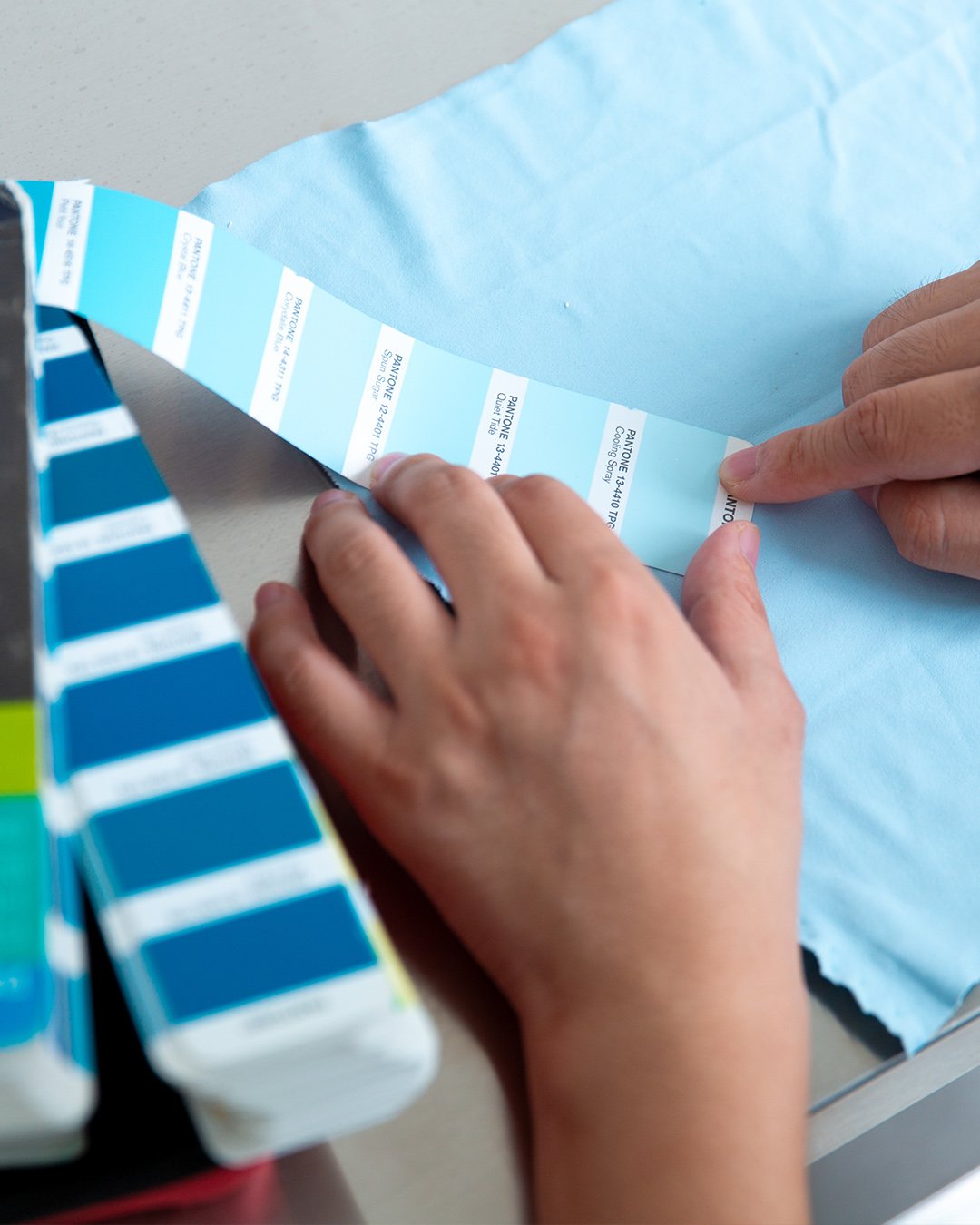
After sealing, bulk begins. Step one is marker making: nesting the full-size patterns across the fabric width for the highest fabric utilization. Every 2–3 percentage points of utilization swings the whole batch's fabric cost visibly — we touched the mechanics in our cost guide, but that piece explains "why it is expensive" while here we explain "how the factory saves." Layered ply count, stripe and check matching waste, defect-avoidance cutting — these are real numbers in the marker maker's hands.
Out of the cutting bed come bundled cut pieces, sorted by color and size, into sewing. One crooked cut and everything downstream shifts — so this gate's tolerance control matters more than many imagine.

6. Gate 5 — Sewing line balancing: flatlock and bonded, and why we do not do Santoni
The core of the sewing stage is line balancing: splitting a garment's dozens of operations across stations so every station's cycle time matches and the line never jams. Operation allocation is directly driven by seam type — four-needle six-thread (flatlock) uses more thread and machine time than overlock; bonded seamless replaces stitching with adhesive film lamination, a different tier of equipment and process control. We run flatlock and bonded; we do not do Santoni circular-knit one-piece seamless — that is a different route to seamless, outside our capacity, and whenever we write "seamless" we mean bonded only, implying no Santoni capacity and taking no Santoni orders. Decoration operations (print / embroidery / heat press) also consume capacity here, and each method's throughput impact at volume is detailed in our print method guide. Well-balanced lines squeeze a stable extra slice out of the same dual-plant capacity.
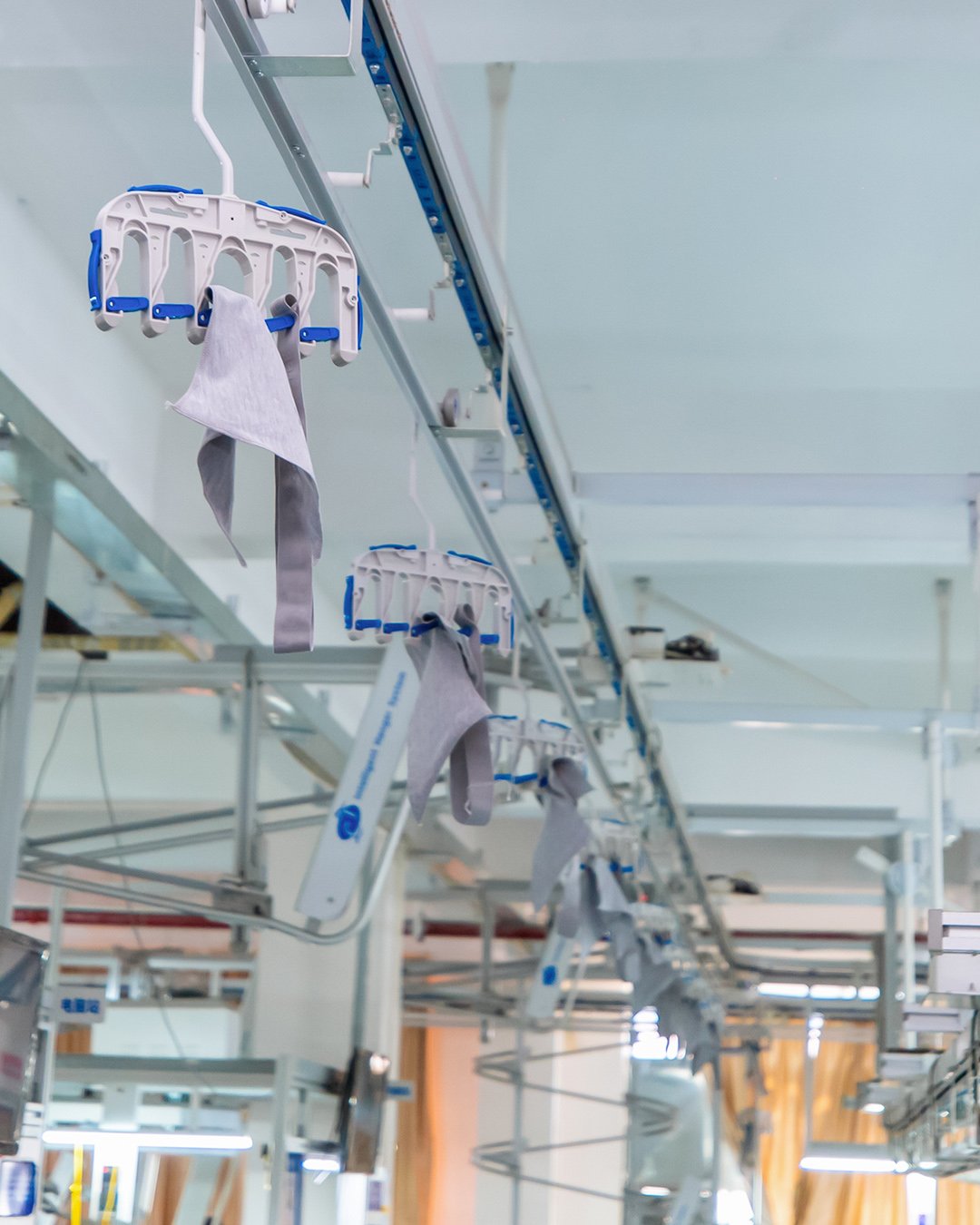
7. Gate 6 — Finishing and QC: inline and final, what to watch at AQL 2.5
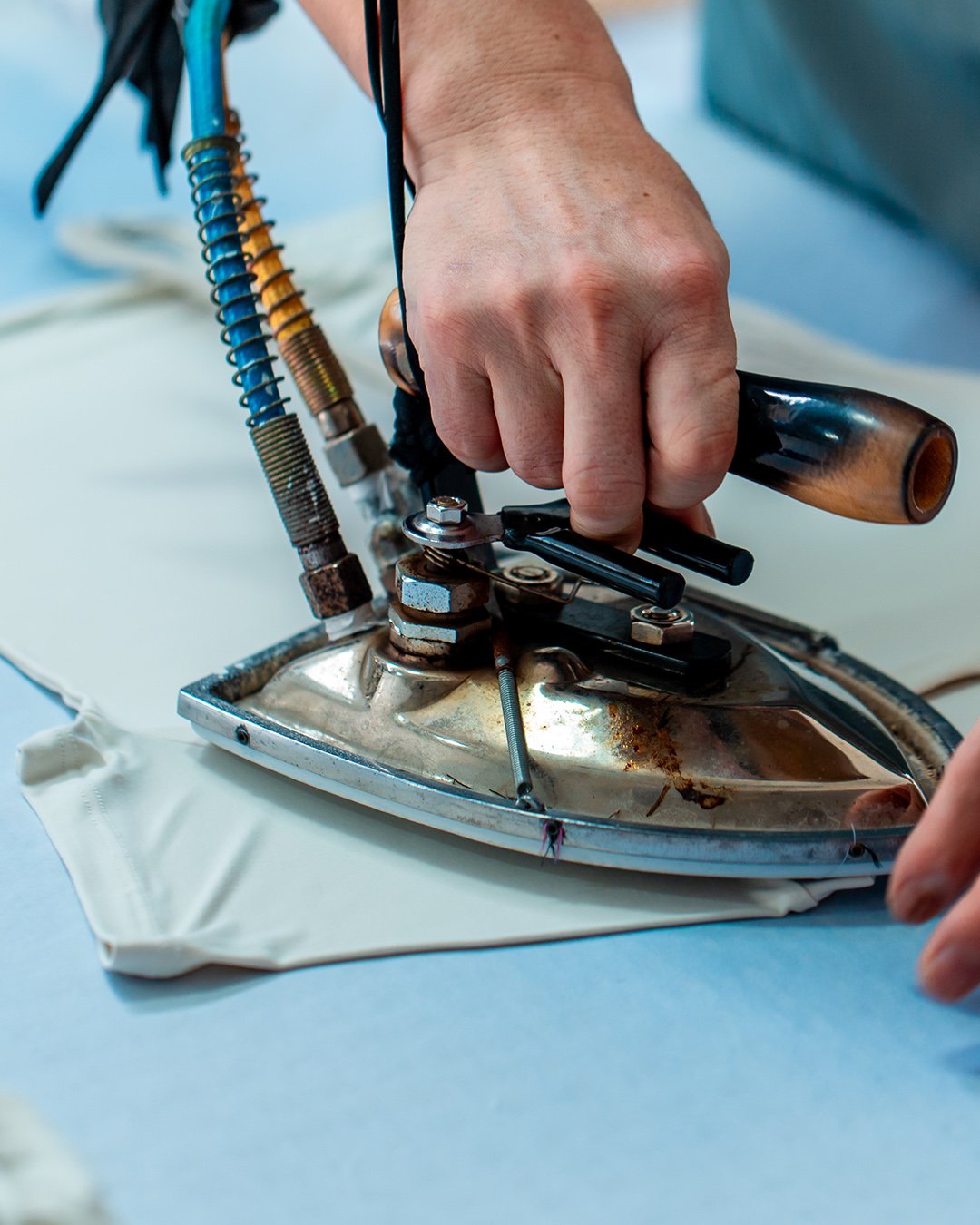
A garment sewn is not finished. Finishing covers thread trimming, pressing, inspection and hang-tagging. QC has two stages: inline (in-process check) catches at each station on the line; final (end check) samples by AQL 2.5 before finished goods enter storage. Most buyers only watch final, but what actually holds defect rate down is inline — problems stopped at the first station, not stacked to thousands before discovery.
What buyers often miss: write the AQL level and inspection party (self-check / third-party) into the contract. Vague "we want good quality" equals zero in a dispute. Put acceptance standards into the PP sealed sample and QC has something to stand on.
8. Gate 7 — Packing and FOB Shenzhen shipment
The last gate is packing and shipment: carton specs, fold method, and the documents in the carton (packing list / invoice / compliance attachments). We default to FOB Shenzhen — Shenzhen is the port of shipment, not the place of production (production is in Dongguan + Guangxi). We broke the lead-time line in our lead-time guide, but here is the point: bulk lead time starts the day the PP sealed sample is signed, not the day you place the PO — every day saved at the earlier gates is a real day on the later lead time.
9. Buyer self-check list: what to prepare before each gate
Run this list against your development flow and the 8 gates will go much smoother:
- Before Gate 0: are the five tech-pack items complete (construction spec / size chart / fabric-trim bill / placement sheet / packing instruction)?
- Before Gate 1: is the base-size sample confirmed and are grading tolerances aligned with the pattern room?
- Before Gate 2: is at least one sample revision room left (not rushing the 7–10 days)?
- Before Gate 3: are you ready to sign the PP sealed sample, instead of carrying "good enough" into bulk?
- Before Gate 5: are seam type (flatlock / bonded) and decoration method locked, to avoid rebalancing the line?
Standard bulk MOQ is 300 pcs per style per color, and new clients can trial 100 pcs per style per color on a first order — Small Batch Production still runs all 8 gates, only the setup and changeover cost spreads across fewer pieces. Prepare the list before sending the tech pack and what you get is a predictable production line, not a string of fire-fighting calls.
Most "unreliable factory" complaints, traced back, are details released before PP sealing. After the drawing reaches the factory, every one of these 8 gates you argue over a little more means one less bulk rework. Line execution is worth more than the slogans on a factory brochure.
When do the 7–10 sampling days start?
From the day we receive a complete tech pack and confirm manufacturability, not from the day you say "want to make." The more complete the brief, the faster the review, the earlier the sample. A vague brief first burns days in the DFM stage before sampling even begins.
Can I still change color or fabric after the PP sealed sample?
Yes, but it reopens purchasing and first article, directly eating lead time and cost. That is why the sealed sample is defined as the "contract sample" — its entire purpose is to lock every variable before this point. Changing small (e.g. a same-GSM same-composition color) costs less than changing big (swapping fabric structure), but neither is zero cost.
If bulk differs from the sealed sample, who is liable?
The PP sealed sample is the reference master. If measurements / construction / fabric match the sealed sample and you are still unhappy, it is the factory's responsibility; if you changed the brief mid-way and still accept against the original sealed sample, it is the brief's responsibility. This is exactly why acceptance standards must be written into the sealed sample, not left verbal.
Can a 100-piece trial order still run all 8 gates?
Yes. Small Batch Production runs the same tech-pack review, pattern grading, sample, PP sealed sample, cutting, sewing, QC and shipment. The only difference is fixed cost (setup / changeover) spread across fewer pieces, so unit cost is higher — that is the natural property of a trial order, not an extra factory charge.