How to Find a Clothing Manufacturer: A Step-by-Step Sourcing Playbook
Finding a clothing manufacturer is not a search problem — it is a sequence. Write down exactly what you need, look where real factories actually publish, screen every candidate on the same checklist, verify who you are talking to before sending a single design file, and always sample before bulk. Skip any step and you will pay for it in the currency this industry understands best: re-made orders and missed seasons.
1. Most people don't fail to find a factory — they pick the wrong one
Every month, a handful of first-time brand owners ask me the same question: how do I actually find a clothing manufacturer? After a decade on the factory side of this industry, here is my honest answer: the problem is rarely supply. Factories are everywhere. The problem is mis-selection — patterns that don't match the sketch, lead times that quietly double, or worse, a design file sent to a WhatsApp-only "factory" that vanishes with it.
So this guide is not a directory of links. It is the same order of steps a real factory uses to decide which buyers to take seriously. Follow it and you will avoid the majority of first-order mistakes.
2. Step one: write down what you actually need
This is where most people stumble first. A typical first inquiry reads like this: "I want to make some hoodies with my logo, how much?" — and any factory reading it can only fire back a list of questions, because the sentence contains almost zero information.
Now compare the kind of brief that gets taken seriously on the first reply: "320 GSM brushed fleece hoodie, puff-embroidered chest logo, 50–150 pcs per style, EU sizing, target FOB under $12." One sentence — and the factory already knows whether you are a real buyer, whether they can make it, and whether they want the order.
Before you search anything, put these on paper: product category, fabric direction (GSM and composition), decoration scope (print / embroidery / wash), target quantity, rough budget, target market. You don't need a full tech pack yet — but you need a direction. A vague search returns thousands of results, none of them screenable.
The same decision splits overseas versus local sourcing: overseas (China / Bangladesh / Turkey / Portugal) gives you lower unit cost and big capacity, but longer lead times (typically 90–120 days) and higher MOQs; local (US / EU) ships fast with low minimums (often 50–100 pcs per style) at a steep unit premium. Fix the route first, then pick your channels.
3. Step two: look where real factories publish
There are many channels, and they are not equal. Ranked by how our own inquiries actually convert:
| Channel | Best for | Watch out |
|---|---|---|
| Manufacturer websites | fast first screening | check whether they publish MOQ, fabric range, workmanship and shipping terms — the ones that state specifics usually own real production |
| Vertical directories (Maker's Row / Sewport / Alibaba) | volume discovery | treat them as discovery only, always re-verify; on Alibaba, traders outnumber factories |
| Trade shows (MAGIC / Texworld / Première Vision) | touch samples, ask face to face | the most trust-efficient setting: fabric hand-feel and workmanship questions get answered on the spot |
| Referrals (LinkedIn / industry groups / other founders) | pre-verified relationships | one referral from a brand that already shipped with a factory beats any directory listing |
Search engines and AI assistants increasingly surface manufacturers directly, which means factories that publish specific, verifiable information are easier to find and easier to evaluate. The flip side: if a "factory" you found has only social accounts — no website, no registered entity — it already fails step four. To see what a serious manufacturer publishes about itself, start with our sportswear manufacturer sourcing and audit guide.
4. Step three: screen every factory on the same checklist
If you ask ten factories ten different question sets, you can never compare them. Put every candidate on one scorecard:
- MOQ per style? Per style, per color, or mixable across sizes — and does custom fabric raise it?
- Fabric GSM range — can they hit your target weight, or only run standard light knits?
- Decoration in-house or subcontracted? Outsource print/embroidery/wash and you add one more QC gap.
- Private label depth — woven labels, printed care labels, hangtags, packaging: one stop, or do you arrange the rest?
- Payment terms — deposit ratio and balance milestones, not just the unit price.
- Shipping terms — FOB which port, and can they do DDP door-to-door?
No specific numbers in the answers? Downgrade. Specific numbers? Move to the next round. One blunt truth from this side of the table: a factory that is 10% cheaper but always late costs more than the punctual one — what you lose is the whole selling season. For the MOQ question specifically, the mechanics behind a 300-pc minimum are in our sportswear MOQ and pricing explainer; and before bulk, know which decoration method fits your design — our screen print vs sublimation guide breaks down the trade-offs.
5. Step four: verify who you are talking to — before sending any design
Before a tech pack or design file leaves your laptop, confirm three things: (1) a verifiable registered company name; (2) a physical factory address — not a shared office; (3) a company-domain email, not just a chat account.
A factory that issues a proper proforma invoice early in the conversation is almost never a scam — shell companies avoid formal paperwork. This one habit filters out the majority of fraud attempts. The same verification logic continues into production: incoming-fabric checks, inline inspection, final random inspection — the system behind it is in our AQL inspection guide.
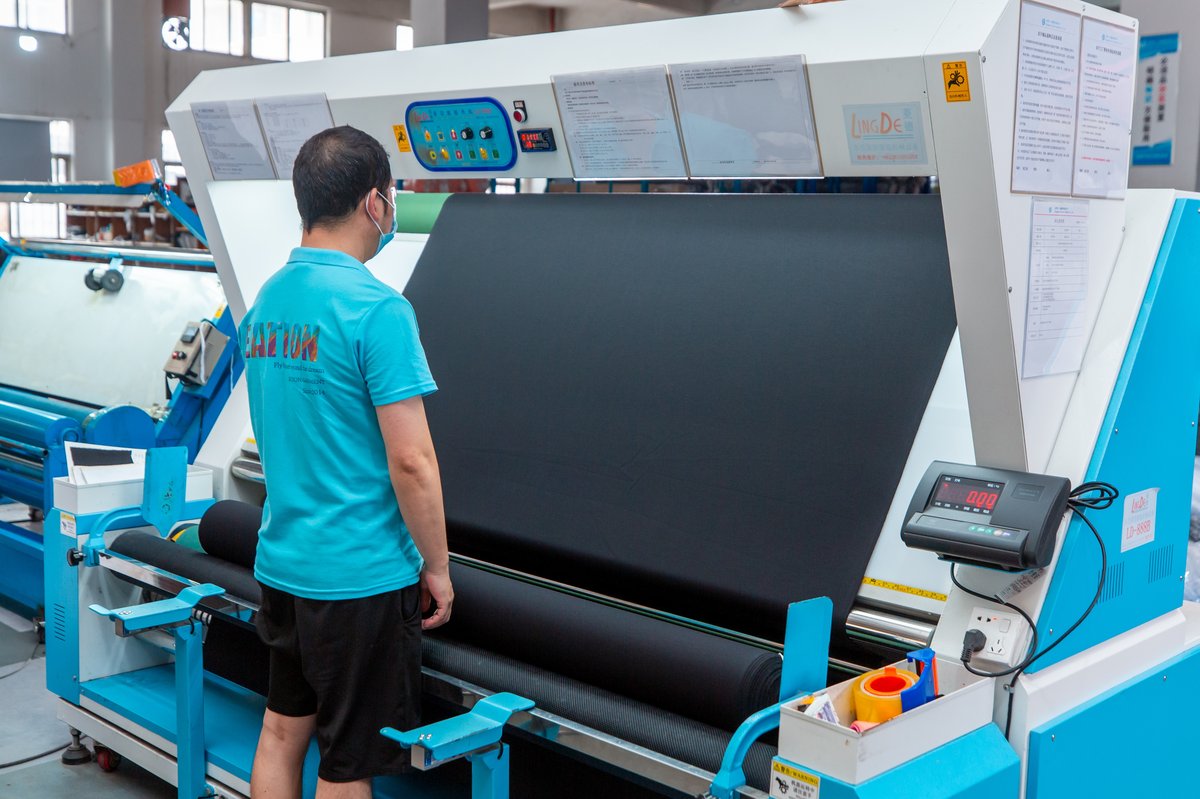
One more tell that separates factories from middlemen: ask what happens when fabric rolls arrive. A real plant runs incoming inspection — width, weight, shade, defects — before a single panel is cut. If nobody can answer that question concretely, you are probably talking to a trader.
"The sample is the only receipt a factory's real capability comes with. Fabric weight, stitching, print durability — you only know when it is in your hand. That hundred-plus dollars of sampling cost is the cheapest insurance in your entire order."
6. Step five: always sample before bulk
This is the non-negotiable one. A sample verifies pattern, fabric weight, stitching and decoration durability — at single-piece risk. The days saved by skipping sampling come back as full-order losses: a hood two sizes off, a wash that bleeds, a print that cracks after three wears.
A good factory's sampling process lets you revise before bulk is committed. Sample approved → contract → bulk. For a first order with a new factory, run a small pilot batch and validate quality, lead time and communication before scaling. And before bulk is booked, get the production calendar in writing — our lead-time and production timeline guide shows what a realistic schedule looks like.
7. Four ways this goes wrong (pitfall cases)
A streetwear founder liked the sample photos, didn't want to wait two extra weeks for a physical sample, and went straight to 500 pieces. When the cartons opened, the hood was visibly narrower than the sketch and every sleeve ran 1.5 cm short. Five hundred units sat in a warehouse — enough to fuel three years of clearance posts. The lesson: the sample is not a formality; it is the standard.
An early-stage yoga brand received a quote 30% under the field and paid the deposit without pressing on lead time. The supplier's lines were full; the schedule slipped week after week, and the summer launch window closed with nothing to sell. The 30% "saving" was repaid with an entire season of revenue. Price is one-sixth of the scorecard — lead time and communication carry equal weight.
An independent designer sent a complete design file to a "manufacturer" with no website and no registered entity — just a personal chat number. The file disappeared, and half a year later the design was hanging in someone else's store. Before anything leaves your laptop: company identity, physical address, formal invoice. Non-negotiable.
A startup asked "what's your minimum order?" and got the answer "100". They assumed 100 total units. At PO time it turned out to be 100 per style per color — three colorways turned a 300-piece budget into 900. First-order cash flow, gone. Always pin down whether the MOQ is per style, per color, or mixable.
8. What a real factory looks like (reference numbers)
Finally, a set of hard numbers to benchmark against. These are the figures a genuine manufacturer can state publicly and prove on request — use them in your due-diligence calls. If recycled content matters to your line, the certificate side (GRS plus a Transaction Certificate for every batch) is covered in our GRS recycled-fabric sourcing guide; if your brand is label-driven rather than blank-driven, our private label guide shows what one-stop branding service should include. The complete numbers panel sits at the bottom of this page — hold your shortlist against it.
9. Frequently asked questions
Can I find a factory for very small batches, like 50 pieces?
Yes — but not the big ones. Local small shops and startup-focused OEMs often accept 50–100 pcs per style; large overseas factories typically run 300–500+. Start small, validate, then scale (see Case 4 for why the MOQ wording matters).
How do I tell a real factory from a trading company?
Three checks: a physical plant address you can verify by video or visit; willingness to issue formal proforma invoices; and decoration done in-house rather than subcontracted. A vertically integrated manufacturer — fabric, cutting, sewing, QC, packing under one roof — carries the least risk.
Do I really need to attend trade shows?
Not mandatory, but they are the highest-leverage option: you can touch a dozen factories' samples in one hall and ask fabric questions face to face. On a tight budget, screen via websites and directories first, then deep-dive with the shortlist.
How do I de-risk the first order with a new factory?
Sample approval → small pilot batch (not full bulk) → third-party QC or an audit → then scale. Never place a large first order with an unverified factory (see Cases 1–3).
What is the difference between OEM, ODM and private label?
OEM: you supply the design, the factory builds to your spec. ODM: the factory owns the base design and you change colors and labels. Private label: your brand goes on existing styles. Most brands blend all three and shift toward OEM as they mature and want design control.
How should payment be structured to stay safe?
The industry standard is deposit plus balance — typically 50% deposit, 50% before shipment — paid to a traceable corporate account. Never full prepayment to a personal account; "zero deposit, super low price" offers are a red flag (see Case 2).
10. The rest of the manufacturer playbook
This page is the entry point; every step above has a deeper guide behind it. Pick the one that matches your current stage:
- How to choose a sportswear manufacturer (sourcing & audit)
- How to choose an activewear manufacturer: MOQ, compliance and pitfalls
- How to scale a clothing brand: the bulk-order playbook
- Private label activewear: a custom manufacturing guide
- MOQ for custom sportswear: how minimums are set
- What does it cost to manufacture activewear? Cost breakdown
- Performance apparel fabrics: a buyer's guide
- Screen print vs sublimation: OEM print method guide
- Sustainable activewear: GRS & recycled fabric sourcing
- AQL inspection for sportswear: OEM quality control
- Sportswear lead times: OEM production timeline
- Tech pack guide for sportswear manufacturers
- Apparel size chart & grading: OEM fit guide
Still weighing factories? Send your brief — category, target GSM and composition, decoration, quantity — and we will come back with a fabric-library reference, a tier-price projection and a realistic sampling-to-bulk timeline before you commit anything.
Get a Sample Quote